
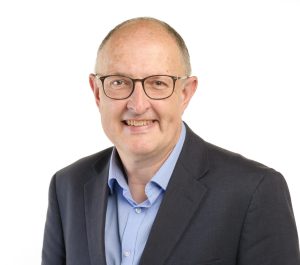
 I graduated from the University of Manchester in 1991, but have worked in Liverpool for the last 26 years. I am a Clinical Academic, which means that I spend half my working week at the University of Liverpool (mostly teaching medical students and doing research) and the other half treating patients who have neuroendocrine cancer at Royal Liverpool University Hospital.
I am currently the clinical lead for the Liverpool ENETS Centre of Excellence NET multidisciplinary team (MDT). This means I lead the team of doctors and specialist nurses who care for patients who have neuroendocrine cancer and live in Merseyside, Cheshire, North Wales and the Isle of Man. As a Gastroenterologist, I mainly see patients who have low-grade NETs in the gastrointestinal (GI) tract and pancreas. Until last year, I was also the Chair of UKINETS, the UK and Ireland Neuroendocrine Tumour Society. I am currently the past chair of the Society, which means that I am still a trustee and member of the Executive Committee.
–
Why Neuroendocrine Gastroenterology?
After medical school and junior hospital posts, I decided I would like to specialise in Gastroenterology. I was attracted to this specialty by the opportunity to treat patients with a wide range of cancer and non-cancer conditions and because I also enjoyed performing endoscopic procedures (camera tests of the GI tract). Endoscopy allows me to look at, assess, and even sometimes treat the condition that I am trying to manage in a patient in real time.
When I was training in Gastroenterology, I didn’t really meet any patients who had neuroendocrine cancer, and it is interesting to reflect that even 25 years ago, this wasn’t even a defined field of medicine.
When I moved from Manchester to Liverpool, towards the end of my clinical training, I started to do research on the hormone gastrin with colleagues in the Physiology Department at the University (where a lot of the groundbreaking research about this hormone, and its link to Zollinger Ellison syndrome, was done in the 1970s). This research led to a career-long interest in the role of gastrin in the development of gastric (stomach) NETs. It also brought me into contact with a fantastic liver surgeon, Mr Graeme Poston. At that time Graeme treated most patients who had neuroendocrine cancers in Liverpool, and he persuaded me to join the embryonic NET multidisciplinary team which he had established in the city. The rest, as they say, is history. Our NET service has expanded considerably over the last two decades. At first, we met once a month and discussed 5-10 patients; now we meet every week and discuss at least 25. My clinical work now entirely involves treating patients who have neuroendocrine cancer, and I no longer manage patients who have other gastroenterological conditions.
–

Mark Pritchard, Rebecca Haynes and Gemma Currie.
–
What does a typical day look like?
One of the reasons I chose to become a clinical academic is because of the variety that this brings to my working week. I spend about half of my week (mostly the first half) working within the NHS and the second half working at the University.
Each week starts with the NET MDT meeting, which runs for about 3 hours on a Monday morning. I chair this meeting, which involves a team of about 15 doctors and 4 nurses as well as Gemma Currie, our dedicated MDT coordinator. We discuss all new neuroendocrine cancer patients who have been referred into our service from another hospital as well as any follow-up patients who may need a change to their treatment based on recent test results.
Our main weekly NET clinic is held on a Tuesday. Alongside other NET physicians from Gastroenterology and Endocrinology, I see several new and follow-up NET patients. We work with two fantastic specialist nurses, Rebecca Haynes and Jenny Prendergast, who see most of the new patients alongside/after one of the doctors, to guide them through the often complex series of investigations and treatments that they may need. Some neuroendocrine cancer patients are also seen in separate surgical, nuclear medicine and oncology clinics, but these are run by other doctors from the NET service. On a Wednesday, I perform an endoscopy list during which Jenny and I assess and follow up patients who have NETs in the stomach and duodenum.
The other part of my clinical work – clinical administration – is less glamorous and most patients often don’t realise how much time it takes. I spend a lot of time reviewing patients’ case notes before discussing them in MDT meetings and seeing them in clinic. I review and act on new investigation results, and I have a lot of phone calls and e-mails with Rebecca and Jenny about various patients who have contacted them for advice. In addition, I have to attend quite a few managerial meetings about our wider service.
In the second half of the week, my clinical work is a little less intense (although I usually still need to deal with several clinical queries from other members of the NET team). On these days I predominantly teach undergraduate medical students, supervise Masters and PhD students, do research and write scientific papers. I believe medical research is crucial to improve patient care in the future, so I try to make sure that this isn’t completely pushed aside by my clinical responsibilities.
One of the things my research group is currently trying to do is to take biopsies from stomach tumours during endoscopy or surgery and grow ‘organoids’ from them in the laboratory. We use these organoids that grow in a culture dish to test the effects of new or established treatments so that we only select the most effective ones to take forward into clinical trials.
As I approach the later part of my career, I no longer have any on call duties at weekends, so I try to use this time to rest and recuperate for the next week. On Saturday mornings you will find me at parkrun. I have now notched up more than 250 runs (albeit quite slowly these days) and my next goal is to complete 100 times volunteering at my local parkrun.
Final thoughts
When I was a medical student, I never imagined what I would now be doing at this point in my career. Becoming a NET physician came to me serendipitously, but I have enjoyed it immensely. I am privileged to be able to treat patients who have neuroendocrine cancers in this era of exciting new and evolving investigations and treatments. This means that for many of the patients that I meet for the first time in clinic, I can be cautiously optimistic that they will be able to maintain a pretty good quality of life for a prolonged period of time. I am hopeful that there will be more advances in treatment over the next few years which will improve this prognosis even more.
Professor Mark Pritchard