
Partner’s Date of diagnosis: May 2025
Where treated: Clatterbridge
Neuroendocrine Cancer Primary site: Pancreas
Treatment now: Everolimus 10mg
–
Mary’s Story
–
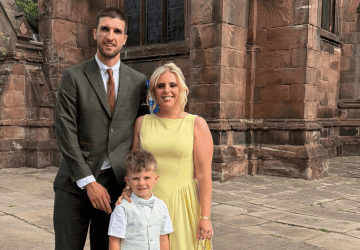
Tom was just 27 when our lives completely changed.
For around seven months before his diagnosis, Tom had been experiencing ongoing abdominal pain. He repeatedly went to the GP looking for answers but was told that he had health anxiety and that drinking too many fizzy drinks was likely the cause of his symptoms. After months of being dismissed, we finally convinced our GP to send Tom for an ultrasound.
The ultrasound revealed tumours on Tom’s liver and something on his pancreas. A biopsy and further scans then confirmed it was neuroendocrine cancer.
That was when our whole journey of learning about neuroendocrine cancer began. Tom was diagnosed with a stage 4, well-differentiated grade 2 pancreatic neuroendocrine tumour (pNET), with metastatic disease in his liver. Neither of us had ever heard of NETs before, so suddenly we were having to learn about scans, biopsies, Ki-67 scores, treatment options and a completely new world of terminology.
It was a lot to deal with.
Being diagnosed so young, and with a young family, has obviously been difficult. We have our little boy Ronnie, and cancer changed the way we looked at our future almost overnight. But a year on, we have come to terms with the fact that this is part of our lives now. That doesn’t mean it’s always easy, but we don’t want cancer to stop us living.
We’ve also had to accept that some things have needed to change. Tom has reduced his hours at work, and I’ve moved into a new job. We’ve had to find a better balance between work, family life, treatment and simply looking after ourselves. We’ve realised that making small changes throughout your cancer journey isn’t giving in or letting cancer win – it’s about making life work for you and allowing yourself to be as well as possible.
Tom is currently taking 10mg of Everolimus daily, which has given him disease stability. We go away, make memories with Ronnie, spend time together, and appreciate the ordinary days that perhaps we would have taken for granted before.
Being the partner of someone with cancer is also a journey in itself. You’re going through it together, but your fears and worries aren’t always the same. There is a lot that comes with trying to keep family life normal, supporting each other, and being there for Ronnie. We’ve learnt to communicate, support each other, and keep moving forward together.
A huge part of Tom’s ability to cope has been his mindset. He always tries to turn something negative into a positive and refuses to let his diagnosis become his identity. That attitude has helped both of us enormously.
We’ve also made it our mission through social media to advocate for patients with neuroendocrine tumours, raise awareness of a cancer that so many people have never heard of, and share what living with cancer actually looks like. The community we’ve built has become such an important part of our journey, and we’re passionate about helping other patients and families feel less alone, especially young people navigating a cancer diagnosis.
We still have difficult days, ‘scanxiety’ and worries about what the future may bring, but we also laugh, make plans, go on holidays, watch Ronnie grow and enjoy our life together.
We don’t know exactly what the future holds, but we refuse to put our lives on hold waiting for it.
We’re living with cancer, not dying from it.
Written by Mary, August 2026