COVID-19 Update October 2020
New restrictions have come into place this week – with a 3 tier system being introduced into England and further actions being undertaken in Scotland, Wales and Northern Ireland
The PMs statement on Monday : https://www.gov.uk/government/speeches/pm-commons-statement-on-coronavirus-12-october-2020
What does this mean ?
The 3 tier system : https://www.bbc.co.uk/news/explainers-52530518
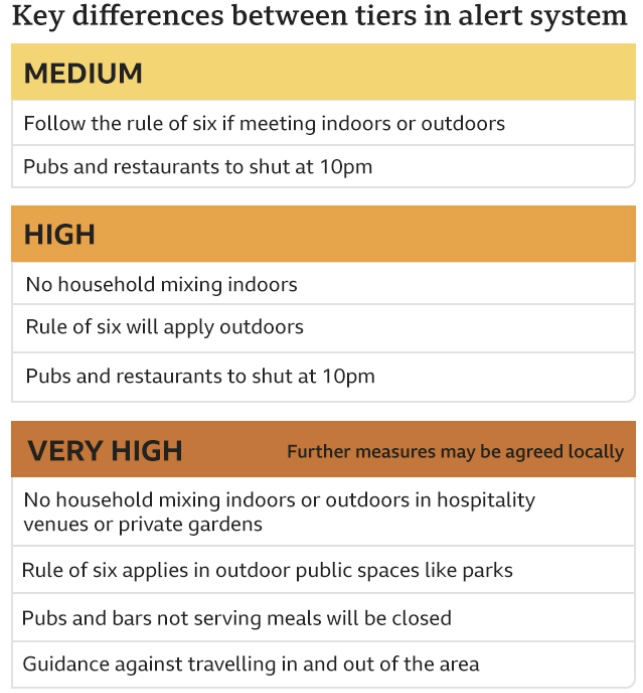
The 3 tiers in brief
To check Covid restrictions in your area : https://www.bbc.co.uk/news/uk-54373904
Latest Updates and information :
For England : https://www.gov.uk/guidance/local-covid-alert-levels-what-you-need-to-know
For Wales : https://gov.wales/coronavirus-regulations-guidance
For Scotland : https://www.gov.scot/publications/coronavirus-covid-19-what-you-can-and-cannot-do/pages/seeing-friends-and-family/
For Northern Ireland : https://www.nidirect.gov.uk/articles/coronavirus-covid-19-regulations-guidance-what-restrictions-mean-you
Previously ‘shielding’ and those considered ‘extremely vulnerable’ – Updated guidance here
People who are defined as clinically extremely vulnerable are at very high risk of severe illness from coronavirus.
There are 2 ways you may be identified as clinically extremely vulnerable:
- You have one or more of conditions listed below, or
- Your clinician or GP has added you to the Shielded Patient List because, based on their clinical judgement, they deem to you be at higher risk of serious illness if you catch the virus.
If you do not fall into any of these categories, and have not been contacted to inform you that you are on the Shielded Patient List, follow the general staying alert and safe guidance for the rest of the population.
If you think there are good clinical reasons why you should be added to the Shielded Patient List, discuss your concerns with your GP or hospital clinician.
People with the following conditions are automatically deemed clinically extremely vulnerable:
- solid organ transplant recipients
- people with specific cancers:
- people with cancer who are undergoing active chemotherapy
- people with lung cancer who are undergoing radical radiotherapy
- people with cancers of the blood or bone marrow such as leukaemia, lymphoma or myeloma who are at any stage of treatment
- people having immunotherapy or other continuing antibody treatments for cancer
- people having other targeted cancer treatments that can affect the immune system, such as protein kinase inhibitors or PARP inhibitors
- people who have had bone marrow or stem cell transplants in the last 6 months or who are still taking immunosuppression drugs
- people with severe respiratory conditions including all cystic fibrosis, severe asthma and severe chronic obstructive pulmonary disease (COPD)
- people with rare diseases that significantly increase the risk of infections (such as severe combined immunodeficiency (SCID), homozygous sickle cell disease)
- people on immunosuppression therapies sufficient to significantly increase risk of infection
- women who are pregnant with significant heart disease, congenital or acquired
- other people who have also been classed as clinically extremely vulnerable, based on clinical judgement and an assessment of their needs. (GPs and hospital clinicians have been provided with guidance to support these decisions)
Care and support – will be available via your local authority
You may be eligible for extra care and support from your local authority. You will receive further information about how to request support from your local authority in the formal shielding notification letter that will be sent to you if your area is advised to shield.
You can still receive informal care at home from people within your support bubble.
You can still receive care at home from professional social care and medical professionals.
If formal shielding is introduced in your area, you will be written to, with information setting out how you can access support, for example, with food, medicines and care.
The government has introduced local COVID alert levels, with rules and advice based on the level of risk in a local area. This updated guidance offers additional advice to the clinically extremely vulnerable over and above local COVID alert level guidance.
This new guidance aims to strike a better balance between providing practical steps to help keep you safe while reducing some of the potentially harmful impacts on mental and social wellbeing that were associated with previous strict shielding.
In the future, the government will only reintroduce formal shielding advice in the very worst affected local areas and for a limited period of time.
This will only apply to some, but not all, very high alert level areas and will be based on advice from the Chief Medical Officer.
For now – refer to the new local COVID alert levels for your area.
The NHS Responder Service is still in place to help anyone who lives in England and who needs to self-isolate for any reason. They can also help people who choose to stay at home as much as possible because they are cautious about going out during the COVID-19 outbreak :https://nhsvolunteerresponders.org.uk/#_ga=2.27623292.1178204270.1602684751-267804704.1602684751
Information about support in Wales : https://gov.wales/find-support-affected-coronavirus
Information about support in Scotland : https://www.mygov.scot/coronavirus-covid-19/
Information about support in Northern Ireland : https://www.nidirect.gov.uk/information-and-services/coronavirus-covid-19/vulnerable-people
Mental Health and Emotional Well-being for all :
NCUK : /how-we-can-help/
Resources and information / useful links : /counselling-and-emotional-wellbeing/
England : https://www.nhs.uk/oneyou/every-mind-matters/coronavirus-covid-19-staying-at-home-tips/
Northern Ireland: https://www.aware-ni.org/covid-19-support
and finally – re Vitamin D – advice from NICE :
There is no evidence to support taking vitamin D supplements to specifically prevent or treat COVID‑19. However, all people should continue to follow UK Government advice on daily vitamin D supplementation to maintain bone and muscle health during the COVID‑19 pandemic.
Rationale
To protect bone and muscle health, the UK Government advises that everyone needs vitamin D equivalent to an average daily intake of 10 micrograms (400 international units). They advise that all people should consider taking a daily supplement containing 10 micrograms vitamin D during autumn and winter months.
They also advise that people whose skin has little to no exposure to sunlight and ethnic minority groups with dark skin, from African, Afro-Caribbean and South Asian backgrounds, should consider taking a vitamin D supplement all year round.
This advice would also apply to people whose skin has little to no exposure to sunlight because they are indoors shielding or self-isolating.
Therefore, UK Government advice during the COVID‑19 pandemic is that everyone should considertaking 10 micrograms of vitamin D a day because they might not be getting enough from sunlight if they’re indoors most of the day.
*Following appropriate testing and clinical management, people with vitamin D deficiency may also be prescribed higher therapeutic doses of vitamin D*.
Neuroendocrine Cancer UK is a UK wide charity solely dedicated to providing support and information to those affected by Neuroendocrine Cancer.
Helpline : 0800 434 6476 : Tuesday – Thursday 10am – 4pm & Friday 9am – 1pm