|
Getting your Trinity Audio player ready...
|
Just two months after our wedding, Jon was diagnosed with a primary small bowel NET with secondary metastases to the liver. Suddenly, we faced an uncertain future and a five‑year life expectancy. Wedded bliss turned sour very quickly.
What followed was a frightening and uncertain period filled with hospital visits, scans, and tests at our local oncology department. No surgery was offered at this time, just surveillance and Lanreotide/Octreotide injections. We felt like rabbits caught in headlights.
After six months, feeling that the local oncology team were out of their depth, we requested a referral to a Centre of Excellence. After his first appointment, we came away with a clearer understanding of what having a NET meant for Jon and discovered possible treatment options. It was a huge relief and lifted a great weight from our shoulders.
Jon’s first treatment was a liver embolisation, which he responded to fairly well. A few years later, he was offered PRRT (Y90). Following this, Jon enjoyed 13 stable years, continuing to work full‑time and lead an active life, with six‑monthly scans and checkups.
In 2022, Jon had a primary bleed which led to a bowel resection, removing all of his tumours and leaving only the liver disease. In 2024, he was told he met the criteria for a new NET pilot scheme: a liver transplant. Being offered this after years of inoperability was amazing – and overwhelming. After a series of consultations and assessments, in 2025 he was added to the list, and four months later the transplant went ahead.
In 2026, we received the news that Jon is currently no evidence of disease. It still doesn’t feel real. We remain realistic and aware of the ongoing surveillance ahead.
We are grateful, but we know how quickly things can change.
Together, we’ve been on a rollercoaster; it’s had its highs and lows. For years, we’ve navigated the NHS system, learning early on that you have to self-advocate, especially when care is split between a Centre of Excellence and a local Consultant. As a couple and as individuals, having a strong support network is vital.
We first attended a seminar at the Royal Free in London, led by Prof. Caplin. It was there we learned about a new patient support group starting in the Bath/Bristol area. We went along not knowing what to expect. Fast‑forward to now, and we’ve been facilitating the group for around 10 years.
Patient support groups are incredibly valuable. You not only receive support from the charity, but you meet wonderful people who truly understand your situation. There is an unspoken understanding of the mental toll, yet also a beautiful bond of friendship and support. It’s a safe space for honesty and vulnerability. It’s not for everyone, and you don’t have to attend every meeting, but simply knowing it exists and that you are not alone can be enough.
For both of us, being part of these groups has been invaluable: hearing different perspectives, sharing experiences, and supporting one another as patients and partners/carers. What we have enjoyed most is helping others, whether that’s listening, offering nonmedical guidance, pointing people in the right direction, helping with transport, giving a hug, referring someone to a Centre of Excellence, contacting NCUK, or simply sharing a coffee and a slice of cake. Simple acts of kindness can make a world of difference. When we first began this journey, there was very little support available, and we are passionate about being there for anyone who needs it.
We have recently become Ambassadors for NCUK and hope to add value by supporting patient‑led initiatives such as support groups and webinars. We are excited for what comes next and how we can continue to give back.
Ultimately, our mission and passion are to ensure everyone diagnosed with a NET has the opportunity to be seen by an MDT that includes a NET specialist from a Centre of Excellence. We have seen countless patients whose lives have been transformed by this. Together, we move forward with hope, gratitude, and a commitment to support others facing their own NET journey.
With love to all travelling this journey.
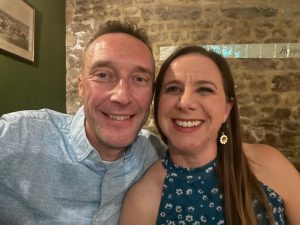
Jon and Emma