|
Getting your Trinity Audio player ready...
|
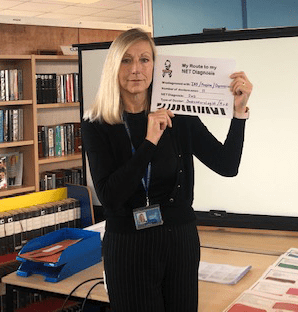 I am a Wife, a Mum, a Grandmother, a Sister, an Aunt and of course, a Friend.
How hard was it for me to hear that the people I loved most were at risk of one day seeing me gravely ill and no longer the matriarch I have always been?
How hard was it for them or them to see me without strength and hope in my character? For them to see me physically change and no longer have answers or offers of help to their current need for my expertise?
I have learned so much and will endeavour to share it with you. It’s not an answer sheet it is simply ’in truth there are no specific remedies, try to look at it this way’…..
Through my communications with the scores of people whose lives are equally troubled by Neuroendocrine Cancer, I have discovered this…
The pain is no less or more for anyone. It too is individual. It takes hold and shifts and rejoices in celebrating through every weakness we have.
Be it patient, carer, friend or family member, when we have feelings for someone we are all hit by the explosion of confusion and feeling that surrounds the fear.
My family of three children, two stepchildren and several grandchildren is built upon a can-do attitude. I brought them all up to be strong! To rise up and overcome adversity. My husband and I didn’t ever indulge in emotional conversations.
And there is a huge depth of love, commitment and joy in abundance throughout each relationship in our family. Yet, I have discovered that this got to ‘get through it, tough attitude’ left a major flaw. For me, there were no words that could be understood by any parties in any conversation about this cancer.
We were taught that in the wider world it is necessary to be positive, strong, and hopeful and believe that tomorrow will be a better day. Social media and feel good stories bombard us with people that fight to the end and stay positive, who live longer and smile in the face of adversity.
But does it tell the truth? Behind closed doors, families are wrestling with the threat to the one they love. Perhaps they just do not handle things very well?
In my large family network there are multiple personalities. I have helped them to develop their own thinking and to be proud of that. Yet it seems to me that there were no words they would happily use with regard to my cancer. They are there by my side but no real conversations about feelings were taking place.
My husband’s face was contorted with control at the words Stage 4 Cancer.
For me this memory will linger forever and the guilt is endless.
As the patient, I seemed to stray into caring for them, yet I was the one with the questions about my quality of life in the future.
My children decided to follow that matriarch’s example and be bold, strong and brush it off. The chink in the armour was visible in the strangest of ways. Behaviours almost regressed to childlike tantrums, young adults vying for attention and for poll position in the ranks. ,Then within a minute shifting to another mode.
The deregulation of emotions was never more obvious when the youngest grandchild asked: “Why don’t people talk about your cancer Grandma?” and suddenly she was the adult in the room – the adults were stunned and silent. This conversation was game changer for us all. Honesty seemed to win.
My support came from speaking with a councillor outside of the family in order to enable me to feel no guilt when I expressed any pain or fear. For me this worked. For others they need the hand of the loved ones at all times and hold a brace position outside of that. If it works for you then that is the route to go down. However, by sharing outside of the family you can also gain others’ perspective and may feel free to ask things you feel afraid to within the family. Family instinct to protect is strong and a hard one to overcome.
Humour also allows me expression of fear without the usual restrictions. Unconsciously, it is a way of expressing and working through my cancer safely in this way. The outcome for me was so positive I have indeed encouraged absolute frankness in amongst all of the family group in this way.
I encourage conversations about the elephant in the room.
We are unable to predict when and if disease or emotions change. I utilise the Natter Support Group who are at the ready to offer support and guidance for me on any matter. Usually it’s about which cake recipe I flopped in, or the impending train ride to the Royal Free Hospital and there’s a lot of toilet talk too. But mostly it’s a chance to seek out the truths, bust up the myths, learn the tips and clues and to feel empowered to face the beast head on for another day. The beast might be emotions or the cancer itself. Many of the Natter Support Group ask questions with each other that they simply would not ask their family. If it works then this ‘is’ ok too.
Do not be afraid to head up discussion and do not be afraid to let others outside your family network assist you in your pain or celebrations if and when they arrive. Allow others to weep and help them seek the level of communication with whom they feel is the best listener. Allow them to be part of the journey if they choose it, ask them if it is what you need and never hold back from the truth.
Sometimes this cancer and its journey gives rise to courage and explicit conversations about how we feel when we least expect it to happen. Never forget sometimes there is power in silence too. Simply diverting and working through stuff that happens in the moment is the most comfortable way.
Whatever route you take, it is your route. Your journey. Your choice. Do what’s right for you. Respect what’s right for others.
Dump the guilt, find the humour and live with honesty. It really is very replenishing.
Be brave and follow your instincts, they are usually right.
Lesley Porch