|
Getting your Trinity Audio player ready...
|
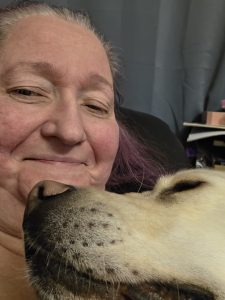
Bethann’s Story
Being neurodivergent, I am especially accustomed to masks: it’s how people like me fit in. But neurodivergent or not, masking is also a hugely important tactic in managing my life with neuroendocrine cancer.
People think they understand cancer, what cancer does, and what it looks like.
They make assumptions that “our” cancer is the same as all the others… and we know how unlike other cancers this is. Other people, however, can’t begin to understand. It’s normal – we do not want to show our dirty laundry in public, or sound like we’re weak. We often struggle to make sense of it ourselves.
So, we mask.
We hide how we really feel, and on days when we can’t hide our feelings, we hide ourselves.
We make a point of looking as good as we can, hoping it will help others, and ourselves, remember that there is more to us than cancer. Sometimes, it works far too well, and we find ourselves overdoing it and crashing. It’s a delicate dance.
But it’s not wrong to want people to see us as competent and strong, even when we feel neither. It’s also not wrong to want people to know that we do struggle, and that sometimes we need their help. In our culture, “not grumbling” is valued. But that’s not always honest and although it’s hard to accept, being honest about how we feel and what we need is important, at least with those people who you love well enough to trust. Oh, and the people who monitor and provide your care… you must be honest with them too. They must know so they can support you.
Having a chronic cancer adds to the confusion.
People expect that those with cancer either get better, or they … don’t.
They don’t realise there is a middle road where you have cancer yet still live, go to work, laugh, smile… at least, some of the time. We know the truth is that we are more than just “cancer”.
It makes us stronger, wiser, more resilient, and more grateful for every friend, every sunrise, and every good day. And sometimes, every good moment. We learn, perhaps the hard way, that life is for living, and of all the things this cancer takes it cannot take away our right to be ourselves as long as life is ours. We learn that sometimes we must take better care of ourselves than we did before, be more understanding, accepting, patient and more forgiving of our own weaknesses, doubts, and struggles. But we sadly learn we cannot expect that patience, acceptance, and understanding of everyone else.
People say awkward things. Usually because they don’t know what to say. They want to ask questions, to understand, to be there for you… but they don’t know how. So, they say: – “You look good today” or “It’s hard to imagine you have cancer, you look so well”.
We nod uncomfortably, and say thank you, and inside we are conflicted, maybe a bit sad, and most certainly it reminds us that we are different than we used to be.
What might not instantly spring to mind is that the other person is really saying “I don’t know how to say it, but I care…”. We can choose how much we share, or when to hide, but what we mustn’t do is hide from ourselves. It’s ok to say “Yeah, today is a good day”.
It’s also completely ok to say, “I’m glad I look good, because I don’t feel that way… can we talk sometime?” – if that’s what you want to.
You can be as tough and strong as you want… if you remember it’s not weaknesses to share, honestly, with the people you trust and love.