
|
Getting your Trinity Audio player ready...
|
WORKING WITH CANCER
What do you do when your employer is expecting the worst for you ‘just’ because you have had a cancer diagnosis?
What do you do when you still love getting up every day and doing your job, just like so many others?
What do you do if it is simply not the right time perhaps due to financial commitments to just stop earning a living?
The ‘C’ word has a magic way of startling employers, and leaving patients feeling totally afraid.
The NET acronym can cause confusion and before you know it, you’re in a whirlwind.
For the first time in my life I knew how the hamsters in the wheel felt. I felt exposed to the world, everyone else was deciding what was right for me and no one thought to ask me, ‘what do you want?’
It felt like I simply had to keep chasing the wheel and hopefully someone would decide for me how fast I should go, or for how long. Everyone else seemed to decide to watch over me with everything I did. That included work. I kept going and simply ran to keep everything just as it used to be.
Yet nothing was ‘as it was’. My world had crashed. It brought confusion, a numbness and above all, total fear.
I was unable to decide anything for myself because my employers had suddenly taken over my thinking with regard to my career. Endless talks of benefits entitlements and pension rights…at 52! This all became very demoralising.
Background
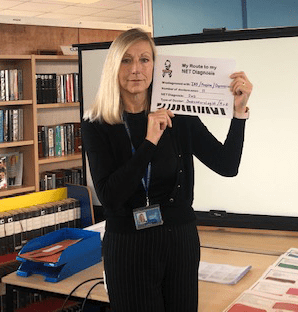
After three troubled years with poor physical health resulting in a total collapse, I was diagnosed as Stage 4, Neuroendocrine Cancer. Eight years ago, I had major surgery which was actually downplayed by my local medical team, which of course fed into my work scenario. I had to take significant time out to recuperate. But I am so glad I did. My working performance prior to diagnosis was committed, yet, on reflection my output was less than top speed. I felt punished, humiliated and a failure. The guilt and lack of empathy for self was spiralling. This all added to my own belief that: Cancer Patients do not / cannot work.
But after lots of research I found myself connected to others in my situation via Neuroendocrine Cancer UK – and began to slowly unpick the myths and the fears and pressure surrounding my situation.
My employers remained sympathetic in their response, yet had taken a shift into being very directive about options available to me as ‘a cancer patient’. To return to work was ‘acceptable’. That stung after 15 years committed and driven service over and above contractual expectations.
It was my ignorance which allowed this. Not just because I was ignorant of ‘Employment Laws’ affecting disabilities that include a cancer diagnosis. It was my ignorance of my right to stand up and say, “NO” to changes in my life that were in fact unjust and unreasonable. That included my employment, my right to remain in work, my right to challenge people’s perspectives and the right to choose over any matter relating to my mind, my body and my financial position. All that was needed was for employers to determine was I safe, and how could I be kept so? That is a very different scenario to work with. If you are not safe then reasonable adjustments must be made as far as is practicable to do so. If that is not possible, then there is a basis for some very sound communication about different ways to move forward.
With a shift in my own thinking, my ability to remain in control of my life and have my occupational cake and eat it, remained in tact. I was fortunate that with the back up of some graceful supporters from Macmillan, the guidance of staff at Neuroendocrine Cancer UK , and my local support group, I had the confidence to gain new employment, even with a cancer diagnosis!
After what was a hugely joyful launch into a new world and only weeks after my arrival in the new place of work the dastardly disease reared its ugly head again, but how different this experience was. The employer stood up to this disease with me and said: “Whatever you need we will support you, you come right back as soon as you’re able”.
I was back within 6 weeks.
My story highlights that it is you who should determine your ability to do your job to the standard you consider to be reasonable. The responsibility lies with your employer to pull out the stops to safely ensure you can. It isn’t always easy, but it’s worth the push to have this routine in your life if it gives you the joy and the rewards or comfort you need.
Today
There are times when I feel rubbish and fatigue strikes. There are endless appointments and demands on the outside of work that pull me every which way. In the main work for me is my strength that keeps me focused on the fact that I am simply me… Lesley. My vocation as the carer, the provider, the driver of change in society which is my passion, has not wained. My cancer does not define me. This spanner in the works will not take my liberty … most days.
There are many that do struggle with unrealistic employers and mindsets that are challenging. I urge all to make a choice about their hopes and to seek to strive for it. Don’t give up because the world says you should, it isn’t the answer. If you choose the right to step out, then do so with a happy heart.
The Future
Under no other terms should you be forced to retire early. Sometimes we are the ones forced to make those decisions to step out. If your heart is heavy seek other ways to fill your soul. There are lots of voluntary organisations that can supported you near. Neuroendocrine Cancer UK is one. Or you can get involved in other areas, like hobbies – and even studying is a great way to occupy the self whilst making new plans.
What do you do if the hamster in the wheel is frazzled yet still running to avoid pressure? You change the size or shape of the wheel – and take some quiet time for yourself. Sometimes, you only need to change the WAY you pursue existing patterns and routines that keep you positive and give you quality of life. Whatever you choose, make sure YOU decide for you.

The Disability Discriminations Act and The Equality Act
There are many sources of help available to those with disability. You have the right to apply for jobs, remain in work and decide whether to declare your disability or not. If you declare it, the Disability Discrimination Act and The Equality Act protects you wholly from that point. If you decide not to, then it is still your choice to manage yourself in the way you choose.
Life is rich and for the taking. Go get it and remember it is always your choice.
I have a mantra: “Whatever makes you feel bad, leave it. Whatever makes you smile, keep it.
Remember to never let anything you cannot do, prevent you form doing any of the things you can.
Happy Thoughts
Lesley.
To find out more about ‘Work and Neuroendocrine Cancer’, click here.