

|
Getting your Trinity Audio player ready...
|
–
I am a Consultant Colorectal and Neuroendocrine Tumour Surgeon at the Royal Free Hospital in London. My surgical practice is fairly evenly divided between colorectal cancer and neuroendocrine tumours (NETs), and I perform around 30–40 NET resections each year. I also chair the Royal Free colorectal cancer tumour board, so cancer surgery and multidisciplinary working occupy a large part of my week.
Why neuroendocrine tumour surgery?
One of the things that attracted me to NET surgery is that it sits at the intersection of cancer surgery, complex anatomy and genuinely multidisciplinary medicine.
Midgut NETs are particularly fascinating surgically. They can be small tumours in the bowel but produce a disproportionate amount of disease within the mesentery, including fibrosis and masses involving major blood vessels. Consequently, the operation is often about considerably more than simply removing the primary tumour. The challenge is to achieve good oncological clearance while preserving as much healthy bowel and its blood supply as possible.
These are also patients whom we may look after for many years. NETs have a very different biology from many other gastrointestinal cancers, and that makes long-term decision-making and continuity of care especially important.
–
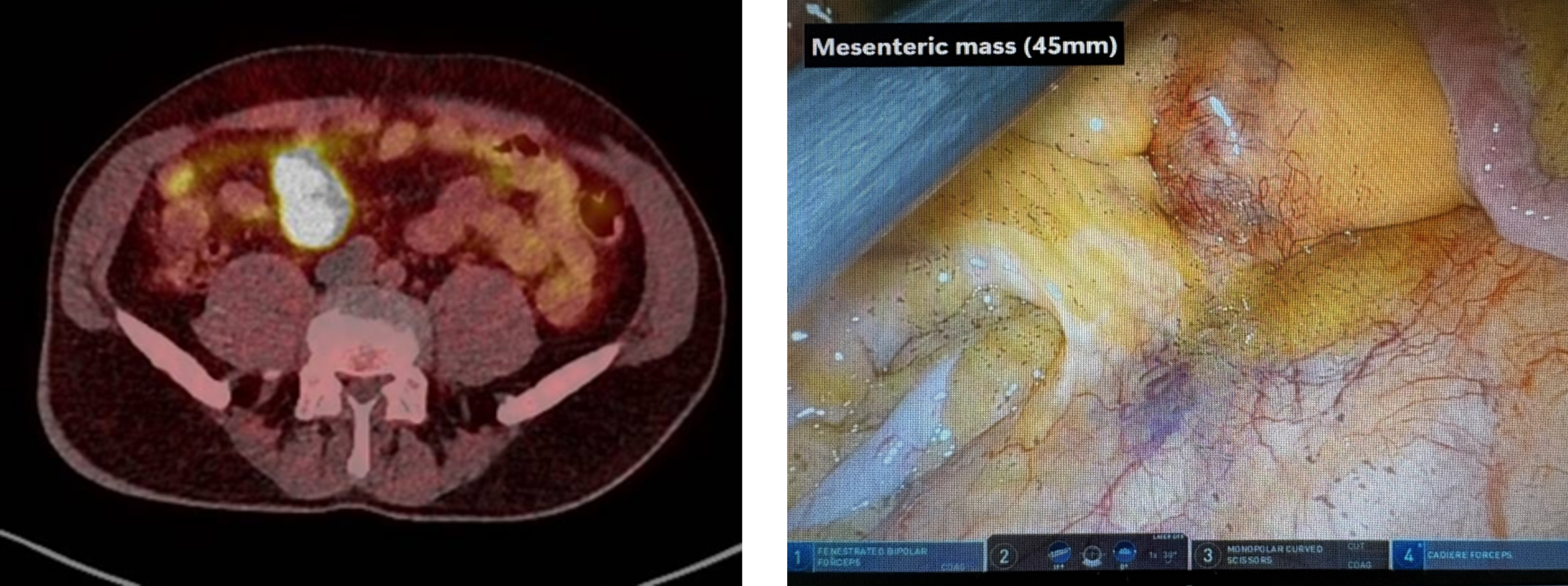
Mesenteric mass PET scan
–
What does a typical week look like for you?
There probably isn’t a typical week in surgery, but Tuesday morning is a fixture. I attend our specialist NET multidisciplinary team meeting at the Royal Free in person every week. This brings together surgeons, physicians, oncologists, radiologists, nuclear medicine specialists, histopathologists and our specialist nursing team.
For me, the MDT is fundamental. Before operating, I want to understand not simply where the tumour is, but its biology, the pattern of metastatic disease and, particularly for midgut NETs, the relationship of mesenteric disease to the major vessels supplying the small bowel.
Good surgery begins well before the patient enters the operating theatre.
The remainder of the week includes outpatient clinics, reviewing imaging and investigations, discussing complex patients with colleagues and, inevitably, a substantial amount of clinical administration. I also chair our colorectal cancer tumour board and have wider responsibilities within colorectal cancer services, so there is rarely much unused space in the diary.
Friday is generally my main operating day. I usually have an extended, three-session operating list, often involving complex cancer surgery, and I take additional operating lists whenever capacity allows.
Changing the way we operate
One of the most exciting developments in my own practice has been the move towards robotic surgery. I have now shifted the majority of my elective operative practice to a robotic approach and find it particularly valuable for precise, complex oncological dissection.
Historically, midgut NET surgery has largely been considered unsuitable for minimally invasive surgery. There are good reasons for that: patients may have multiple small-bowel tumours, extensive mesenteric fibrosis and disease wrapped around important blood vessels. In those circumstances, the priority must always be safe and complete surgery rather than the size of the incision.
However, I don’t think that means we should accept that minimally invasive surgery has no role.
My team and I have now performed what we believe to be the first series of 20 robotic resections for complex midgut NETs with mesenteric masses in the UK. It is an area I am particularly passionate about. The magnified three-dimensional view and precision of robotic instrumentation can be extremely helpful when dissecting around the mesenteric vessels.
The aim isn’t to use technology for technology’s sake. It is to determine whether we can take operations that have traditionally required major open surgery and, in appropriately selected patients, achieve the same oncological objectives while reducing some of the physiological impact of surgery and helping patients recover more quickly.
It is very much a team sport
None of this happens through the work of one surgeon. NET care is perhaps one of the clearest examples of truly multidisciplinary cancer care. I rely enormously on our NET physicians, radiologists, nuclear medicine specialists, oncologists, pathologists, anaesthetists, specialist nurses and my surgical colleagues.
For the most complex operations, planning together is every bit as important as what happens in theatre.
If you could change one thing, what would it be?
My wish would be for every patient with a NET to have access to specialist, individualised care and for us to continue challenging assumptions about what is surgically possible.
In midgut NET surgery specifically, I think the next frontier is combining advanced imaging, three-dimensional reconstruction and robotic technology to understand each patient’s mesenteric vascular anatomy before and during surgery.
Ultimately, innovation only matters if it translates into something meaningful for patients: safer surgery, preservation of healthy bowel, faster recovery, better cancer outcomes and a better quality of life. That is what makes this field so rewarding, and why I remain so enthusiastic about where NET surgery can go next.
Dr Reza Mirnezami