|
Getting your Trinity Audio player ready...
|
Name: Maxine
Neuroendocrine Cancer Site: Primary site: Small Bowel
Centre of Excellence: Newcastle Freeman
Diagnosed: 2015
–
Maxine’s Story
I was diagnosed in November 2015 – and operated on in January 2016 as an emergency. No time to spare to persuade myself that I could manage all this … but I do.
This is an update on some of the ways I’ve learned to cope. To ‘live with’ neuroendocrine cancer.
Probably the most helpful has been journalling. I use it to help me manage the ups and downs of daily life. The technique was suggested to me during my various mental health wellbeing courses that I’ve undertaken over the years.
I don’t use it every day, but for me it really helps getting the negative thoughts out of my head and onto paper. If I don’t manage to write things down, I find the thoughts and ideas keep coming back, and usually bounce around in the middle of the night.
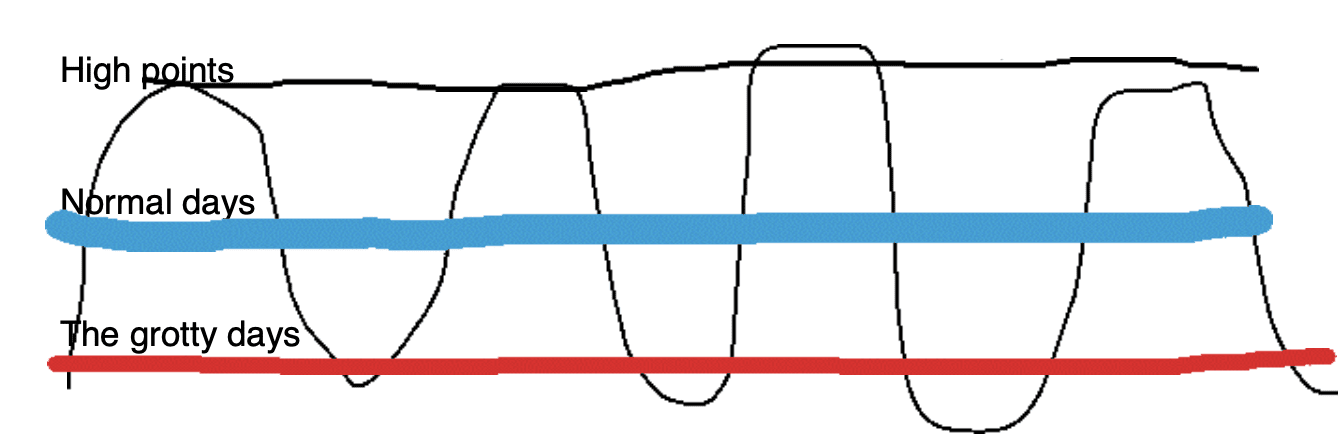
Recently, I’ve had a good couple of months, with nothing too dramatic happening – either positive or negative – which for me, is good news. So, when I was journaling, I decided that I would also try to draw and show how I was feeling. I thought that if I drew a clear pattern of my weeks; there’d be a real up and down graph line, and that I’d be skipping along the top of those loops. When I’m feeling ok, or even good, I kind of fool myself that I’m functioning along the top of those loops most of the time.
–
–
But of course, I’m not.
When the inevitable hiccups occur, I used to feel angry and disappointed. Annoyed with myself that things weren’t perfect. Of course they’re not, I live with all the usual neuroendocrine cancer issues. But, mostly, my days are ok. And how lucky am I, to be able to say that?
But I do have very urgent dashes to the loo. If I eat something I shouldn’t, it will rebound on me – and that takes some managing.
Sometimes my injections are a doddle. Painless. Other times the pain in my hip joints and back can be agonising.
My emotions are on a trigger hair. I can collapse into an emotional heap at nothing. All fairly normal neuroendocrine cancer territory.
What I have begun to accept and understand is that all of this is normal. The vagaries of my neuroendocrine cancer life tracks along the middle of the graph line, some good, some bad. Acceptance helps me be more resilient and cope when there’s a downward blip.
And, those high points are just that! Exceptional days, when nothing hurts.
I can manage a day out and not have a panicked dash to the loo, even eating out and feeling good.
And, the red grotty days for me are where I get up, start my day and suddenly my legs are empty. Huge fatigue. Everything has drained out and I haven’t even done anything. The pain and discomfort, and the impotence and helplessness infuriates me. Suddenly my loss of independence becomes a major issue.
Instead, I decided I could and would continue to do all the things that I used to do. And it’s taken such a very long time to admit to myself that I have to accept and adapt. I plan; limit what I want to do. Energy is a precious resource – I try and manage my usage so that I get the best out of each day.
Living with Neuroendocrine Cancer is a phrase that trips of the tongue, but it’s blooming hard to achieve. My resilience is understanding and accepting that the blue line in the middle of the graph lines is now my normal.
It’s only taken ten years! Slow learner or what?
Maxine
Jan 2025