|
Getting your Trinity Audio player ready...
|
A day in the life of …
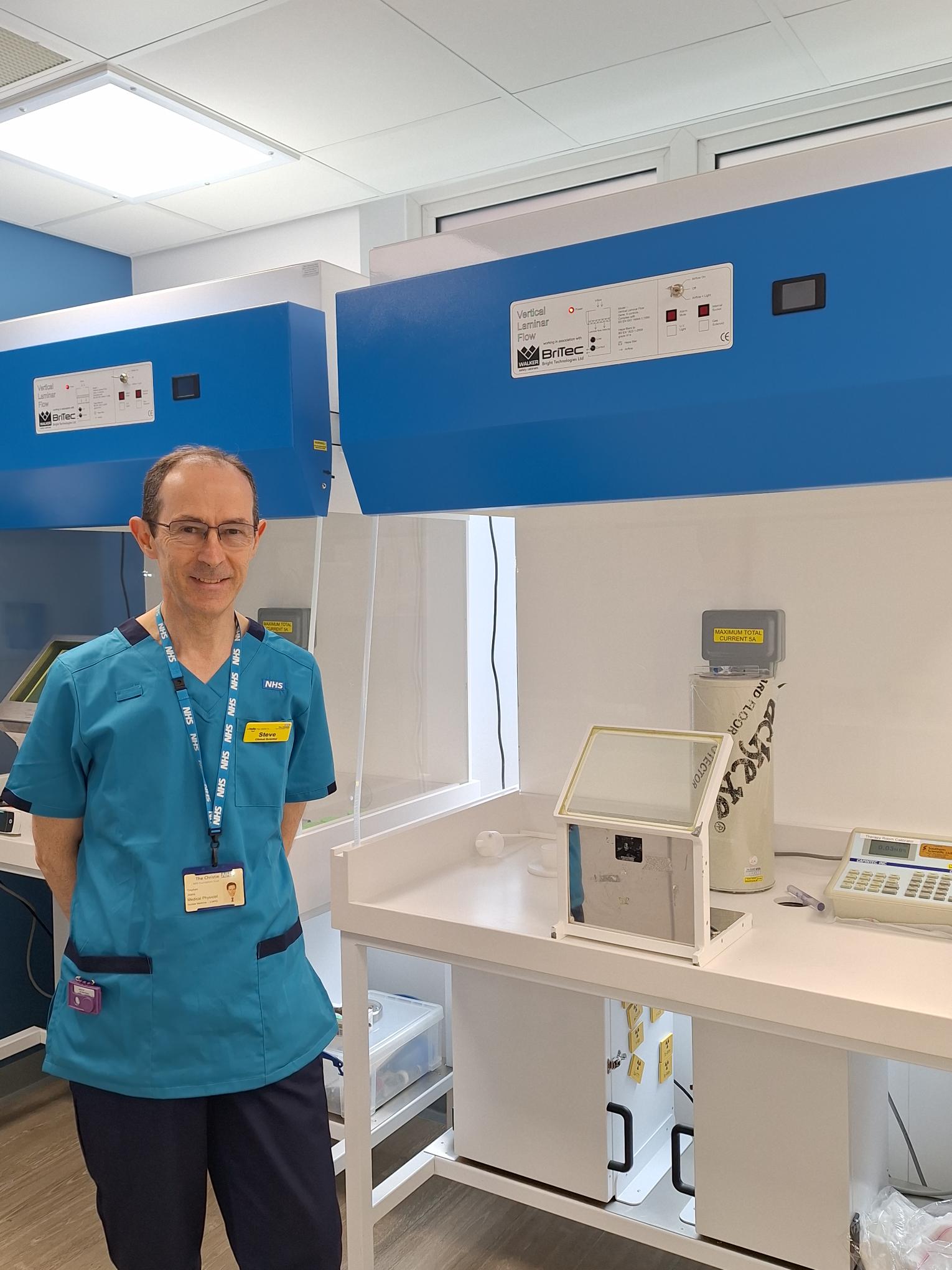
My name is Steve Jeans, and I am a clinical scientist working in the Nuclear Medicine Department at The Christie NHS Foundation Trust in Manchester. One of my roles is to help with the delivery of Peptide Receptor Radionuclide Therapy (PRRT) to patients with neuroendocrine tumours (NETs). As a scientist, a medical physicist to be precise, my role is more involved with the technical aspects of treatment delivery.
How did I get to where I am?
Having chosen to do physics at university and then getting a summer job working at a hospital, I realised that medical physics would be an ideal career for me, relying on my skills as a scientist, whilst being able to help others. When I tell someone that I am a medical physicist, I often get blank looks and have to explain what I do. Essentially, medical physics covers all applications of the physical sciences in medicine, and there are lots of them. I work in Nuclear Medicine, which involves the administration of radioactive materials to patients, which can be for either diagnostic or therapy purposes.
Most medical physicists will have started their career by getting a degree in Physics and then specialising in medical physics via a training scheme route. This leads to state registration and potentially qualification as a Medical Physics Expert (MPE). As medical physics is a fast-evolving field, all medical physicists need to stay up to date with advances in their field, so have to demonstrate ongoing continuing professional development (CPD) to maintain their registration. I started working at the Christie all the way back in 1982, straight after leaving university (and long before PRRT had been introduced!).
Working with ionising radiation
There are many types of radiation, but the type we work with in Nuclear Medicine is termed as ionising radiation as it causes ionisation as it passes through matter. If it passes through our bodies, this can cause cell damage, although at low levels of radiation, our bodies can recover and no lasting damage will result.
However, we can use high doses of radiation to our advantage to selectively target diseased cells within a body, including Neuroendocrine Tumour cells. As ionising radiation can be dangerous if not used carefully, there are laws surrounding the safe use of radiation and the physics team spend time ensuring that we are meeting our legal requirements, have risk assessments in place, conducts audits, etc., to stay within the law and keep patients and staff safe. The physics team will also check that we can meet the requirements of any clinical trials in which we are taking part.
Peptide Receptor Radionuclide Therapy (PRRT)
In brief, PRRT involves the administration of a radiolabelled peptide which binds to specific receptors that are abundant on NET cells and delivers a localised radiation dose to the diseased cells whilst sparing healthy cells. The treatments are typically given over 4 treatment cycles, 8 weeks apart, although this can be tailored for each individual patient. One side effect of these treatments is that it can affect certain blood counts, so may result in a reduced number of red cells, white cells or neutrophils, another type of white blood cell. However, with time, reduced cell counts tend to recover to pre-treatment levels. Hence, in between cycles, it is important that we monitor blood counts to check that they have recovered sufficiently so that we can safely perform the next treatment cycle. If the cell counts are too low and we treat again, a further reduction would result in even lower blood counts and may lead to the risk of more severe anaemia or risk of infection.
The team
On the day of a PRRT treatment, the patient will typically see a nurse, a clinical technologist and consultant who may spend a lot of time with them. However, there will be other team members working behind the scenes and doing tasks such as making appointments, sending appointment letters, ordering the treatment dose and other such admin tasks which are essential to making the treatment happen. There will also be at least 1 medical physicist who patients may see during the treatment day but will also be doing a lot of work behind the scenes.
–
–
The medical physicist’s role in delivering PRRT
As a medical physicist, one of my first tasks will be some equipment QC to make sure that our equipment is working properly. The consultant will prescribe a treatment activity which is tailored to each patient’s individual circumstances, and we can only ensure that we administer the correct activity if we know that our activity calibrators are working correctly.
Once this is done, our next task is to have a “radiation” chat with the patient. Because the treatment will make the patient radioactive, particularly at the sites of disease, the radiation dose will do some serious damage to the diseased cells, but some radiation will be emitted from their body and irradiate everyone around them. Hence, once the treatment is finished and the patient goes home, they will need to keep some distance from others to ensure that no one receives a radiation dose of any significance.
At The Christie, we measure the radiation dose from the patient at various time points after treatment to see how quickly the radioactive dose is leaving their body, and from this, we can calculate how long they will need to stay away from others to ensure that everyone is kept absolutely safe. We discuss this with them before we start the treatment to check on their home circumstances and see if there is anything that might be an issue. It is also a chance for the patients to ask us any questions they may have.
Once the doctor has seen the patient and prescribed the appropriate activity, it is the physics team who get the delivery system ready with this dose. (Note: This may be different at hospitals other than The Christie). This is done in our laboratory area, so the patients don’t get to see this happening. In the past, we have done this by drawing up the correct dose into a syringe and using a shielded syringe driver to inject this into the patient. However, we have now changed our technique and are administering directly from the vial. We run some saline into the vial, which pushes the treatment dose out into a line which is attached to the patient’s cannula in their arm. We are always looking to optimise our procedures, and this new technique is better for both the patient and staff.
Towards the end of the treatment day, the physics team will take the radiation dose measurements from the patient and work out how long their restrictions for contact with others needs to be. We will discuss this and make sure that they understand what they need to do to keep others safe. At the end of the day, or the next day if a patient is staying in the hospital overnight, some imaging of the treatment distribution will be done before they go home.
Why am I still here?
I really look forward to coming to work each day, knowing that I will be surrounded by a team of wonderful colleagues who are all working towards the same goal of improving our patients’ lives. However, the people I admire most are our patients who I often get to know well, having discussed their home circumstances and sitting with them whilst other staff are on their breaks. They can be truly inspiring and the main reason I am still here after 43 years (and counting).
The future?
The field of Nuclear Medicine is always advancing as new therapies are being introduced and better ways of using existing therapies are investigated. There are numerous clinical trials underway, which will hopefully lead to more and better treatment options with better outcomes. It is a really exciting field to be working in.