|
Getting your Trinity Audio player ready...
|
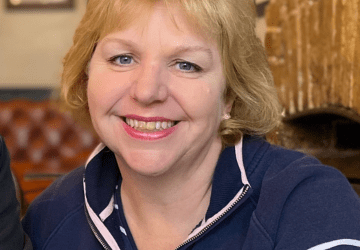
Name: Angela
Neuroendocrine Cancer Site: Ileum
Hospital: Southampton
Diagnosed: 2019
–
Angela’s Story
Living with neuroendocrine tumours (NETS) is such a double-edged sword, isn’t it?
Innately, we want to survive for as long as possible. It’s our basic instinct, and with NETs (Grades 1 & 2) we have the potential of surviving for years, which I couldn’t believe when my local NET consultant said this to me five years ago. How can that really be true? Certainly, it would not be if I had had the much more common form of bowel cancer, adenocarcinoma, rather than neuroendocrine cancer.
The downside to this potentially “great news” of a predicted longer survival time (years rather than months) is that we live with tremendous uncertainty.
We juggle work and priorities, live alongside various very long-term symptoms, and must accept a life where we will never be “normal” again. We embrace a ‘new normal’. It really is a very difficult journey psychologically.
It can never be underestimated just how much it takes to keep positive. But to get the most out of life, we must do this – otherwise the gift of simply being alive is wasted.
We try not to think too far ahead and to live “in the moment”, making the most of today with a sense of appreciation of what is around us and of the remaining health we have right now. We must appreciate things we can do now and forget the things we can’t – and try not to worry about what lies ahead.
Trying to get my head around being a “cancer patient” was mind-blowing at the beginning, and it continues to be a strange concept for me – thinking that the cancer is quite happily doing its own thing inside me whilst I live alongside it. Being Stage 4 (ileal primary removed in February 2020, with pelvic, ovarian, and liver metastases now), I know that I will never be free of it. I feel that it is a bit like the way I felt when I was pregnant – having an alien being growing inside me. Lovely as my children are, it was weird.
Acceptance
As time passes, the concept of having cancer has changed for me, especially as I am someone who looks well despite feeling so dreadfully unwell at times. I have never looked like a cancer patient. If I ever write a book, it will be called: “Oooh, you do look well!” …. Aaargh!
Every time someone says that to me, I could scream inside. But these days, I have accepted my NETs (and my ischaemic heart disease). I have come to terms with the fact that no one I meet will ever have the foggiest idea what I go through. I just smile and say: “I know I do, thank you”. I have better, bad, and dreadful days, but always look so well. Perversely, I think that my severely restricted diet helps me to have a healthy ‘glow’.
I have benefitted greatly from having counselling, initially via Neuroendocrine Cancer UK – for about 18 months at the time of diagnosis, which was invaluable. At that time, I was in shock at my diagnosis and feared what the future might hold (and as a GP Partner, knowing too much clinically about ‘bowel cancer’ was not my friend), especially as my children were only 12, 14, and 16 years old at the time.
The thought of recurrence weighed heavily (in conjunction with dealing with post-op complications and having difficult long-term post-op problems). Every symptom I experienced felt like it could be a potential calling card for metastasis (spread/recurrence), every surveillance scan had every chance of revealing more tumours, even though everything they could see or feel had been removed at the time of my operation in 2020.
I was adamant that my histology and scans proved that the cancer was spreading before the ileal tumours, lymphoid mass, and lymph nodes were removed. My local NET team kept reassuring me that I was mistaken and that I was being too pessimistic. I disagreed. I felt that I was being realistic, not pessimistic, as I knew that it would come back one day, as it was Stage 3c with evidence of micro- and macroscopic spread (9/14 positive lymph nodes, the 3 large primaries had breached the serosal layer of the bowel (broken through the outer wall). There was perineural and lympho-vascular spread and a large 48mm lymphoid mass, which was the first thing they saw when I presented with the pain of sub-acute bowel obstruction way back in October 2019.
I kept living my ‘new’ life – with uncertainty constantly prodding me.
The second time I had counselling was when it was confirmed that I am Stage 4. Finally getting confirmation of my metastases in May 2023 was a huge relief and I felt vindicated in pushing for a diagnosis to explain my new pains and carcinoid syndrome symptoms (facial flushing and bouts of profuse watery diarrhoea with colicky abdominal pains lasting up to 4 hours, appearing out of the blue) which had been present for 18 months.
Prognosis
Having more counselling then was a godsend to help me come to terms with a terminal diagnosis, especially as a mum. I have learned that none of us will ever see all the generations to come and all the events of our children’s lives in the future, so all any of us can do is enjoy ‘now’ and do our best to set our children on the right path. I still have counselling to help me feel that I am ‘not alone’ on my NET journey, and I am part of the confidential online Neuroendocrine Cancer UK Patient Support Forum on Facebook, which is an invaluable source of support and friendship.
I also updated my Will, and did my Lasting Power of Attorney (LPA) for Health & Welfare, and Property & Finances (more here: https://www.gov.uk/power-of-attorney). I got together all my financial information, did an Advanced Directive, which tells your healthcare team about your wishes if you are unable to communicate with them (more here: https://www.nhs.uk/conditions/end-of-life-care/planning-ahead/advance-decision-to-refuse-treatment/) and wrote letters to my husband and children – which I handwrote when I had life threatening cardiac events in Nov/Dec 2023. Coming so close to death really does give one a completely different perspective and focuses the mind on what is important in life.
So yes, as Stage 4 patients we may be classed as having ‘terminal’ or incurable cancer, and yes, our lifespan is reduced, but not necessarily with a quick demise. It really is an odd concept, isn’t it? That ticking bomb… no one can accurately predict our true prognosis or life expectancy. There is no crystal ball.
I was told “you will have up to a decade but not the decades beyond” by my consultant nearly 2 years ago when the metastases were finally identified. In truth, I could well die much sooner because of my severe ischaemic heart disease, or something else cancer-related, or from a curveball…. none of us really knows our future… living with uncertainty is part of our cancer journey.
Over time, our bodies and scans/bloods provide a picture of how our tumours are behaving with stops and starts in that trajectory due to the effectiveness, or otherwise, of various treatments.
I went through a period after my Stage 4 status was confirmed, of thinking “oh goodness, I may only have a few Christmases, birthdays, family holidays left” etc, which is very sobering and depressing. I have shut that thought out now, as I have no idea of what lies ahead. All I can do is make the most of what is happening now, I cannot change or predict the future.
Since taking full medical retirement in July 2024, my life has become full of the things that bring me joy when I feel well enough to do them. I make the most of better days and rest on less good days, and just live alongside my symptoms.
I had spent five years worrying and speculating, and now realise that no matter how symptomatic I am, I have absolutely no idea what is going on inside my body and only scans, bloods, and time will tell me. So, I have consciously stopped myself from thinking about the cancer. This brings so much peace, along with a newfound love of painting, which is a form of meditation. My three-monthly scans are currently stable, so when things progress again, which they inevitably will, I will be prepared for starting PRRT. Until then, I refuse to give my cancer headspace and am hoping that I can maintain the same mindset no matter what stage I am going through. I have taught myself to do this, with the help of my counselling sessions.
As my symptoms and energy levels are so unpredictable, I often have to cancel arrangements at short notice, but everyone knows why and are very accepting. I only book things with that proviso in mind. I never leave the house without my GTN spray in one pocket and my 30 loperamide “instant melts” in the other, along with a charged mobile phone.
I have had tears of frustration and disappointment in the past when I have had to cancel something I was really looking forward to, like my trip to Glyndebourne for a picnic and to see the opera, when I simply couldn’t leave the bathroom and sat crying on the toilet. At that time, I felt that I really hated the cancer (and my heart) and the unfairness of my “bad luck.” It is good to go with those negative emotions and acknowledge them at the time, but it is equally important for me to brush myself off and get back on my horse of positivity again.
The luxury of now being medically retired with a myriad of symptoms is that I no longer need to worry about what I can or can’t do. Things change hour to hour, and that’s fine. I don’t need to drag myself through a working day. It must be very difficult for those who do.
New thoughts
Educated estimates of prognosis are based on research and provide a timespan that people in certain groups may survive. There is great variability within those results, and statistics are used to present those findings in a meaningful way.
I have tentatively started to wonder if I might be one of the “lucky” ones who have longer to live than predicted, rather than always assuming that I will have “up to a decade but not the decades beyond”.
This new thought has perked me up.
I didn’t realise how little hope I had until a new doctor at a NET Centre of Excellence asked: “Why have we not cut the mets out?” I felt my heart skip for the first time in years. That would “reset my clock” if everything they saw could be removed. Further scans and a further MDT have since ruled that possibility out.
However, my excited reaction to this question surprised me. It showed me that I have been living without hope of improvement for years and have had to learn acceptance, which is no bad thing. It is tough, this journey of ours. We are all doing so well to cope with everything that NETs bring us.
Following an unexpectedly stable set of scans in November 2024, despite experiencing worsening symptoms, I made a conscious decision to stop giving the cancer so much head space, and for now have chosen to ignore the symptoms’ meaning and push them aside (yet still live with them, just not give them such importance)… which mentally, is working well at the moment.
For five long years, I fretted, worried, overthought, and researched every aspect of my tumours. I had to be my own advocate, not only for NETS but also for my heart. I am now in a very fortunate, but hard fought for, position of being under the care of two amazing medical teams so I am now leaving it up to them to look after me (I still keep a beady eye on the results and letters though – I’ll never be able to relinquish all control).
If we get periods of stability, we are relieved yet cautious, but are only “let off the lead” for a few months before the next follow-up scans. If not stable, on comes another treatment, and everything that it has to offer, including any side effects. Our roller coaster goes on …. All we can do is keep on keeping on.
There really is much joy to be had. For me, it takes a lot of effort, but it really is worth learning to be resilient, positive, and make the most of now.
Angela
March 2025