|
Getting your Trinity Audio player ready...
|
Name: Chris
Neuroendocrine Cancer Site: Lung
Hospital: Royal Free
We’re delighted to welcome Chris from Wiltshire, who has just joined our Neuroendocrine Cancer UK Ambassador team. Chris was diagnosed in February 2021 by a private lung specialist at the Spire Bristol Hospital, with a primary in his lung known as an Atypical Carcinoid. In terms of Lung NET classifications (sometimes called pulmonary NETS or bronchial NETS), there are 2 main classifications: TC (Typical Carcinoid) and AC (Atypical Carcinoid). These are differentiated by their KI67% score and Chris’s was Ki67 <5% … so AC.
–
Chris’s Story
Initial Diagnosis and Chemotherapy
I had a course of chemotherapy quite quickly after diagnosis, doing 4 out of 6 cycles of Carboplatin and Streptozocin but it was unsuccessful. I asked for a second opinion at The Royal Free London but they didn’t think surgery was feasible. Luckily, one of the Consultant Thoracic surgeons – Dr Igor Saftic at Bristol Royal Infirmary – agreed to try to remove my main tumour and I credit him with saving my life. There’s always more than one way to approach cancer, in my experience.
Lung Surgery and Complications
In Sept 2021 I had a right lung pneumonectomy followed by 5 weeks in the hospital and almost a month in ICU (intensive care unit) for a herniation of the heart, pneumonia, and an infection.
Discovery of Bone Metastases
In August 2022, I started to get some back pain and was referred for an MRI Spine. Then an FDG-PET scan showed multiple sites of bone metastases including my spine, hips, shoulder, left leg, and the base of my skull.
The Importance of Self-Advocacy
This is where I believe self-advocacy comes in. At this point, my local cancer team hadn’t consulted with The Royal Free London NET Centre of Excellence and as a result, told me that only radiotherapy to control pain was an option for me … and that my prognosis was around 12 months.
Taking Charge of My Treatment
Naturally, I couldn’t accept this. I rang The Royal Free London myself and spoke with Prof Caplin, head of the team. We agreed to try both Lanreotide monthly injections and Everolimus, an oral targeted therapy. I didn’t tolerate Lanreotide very well so came off it – but I’ve tolerated Everolimus well so far and at the time of writing (August 2024) I remain on it.
Living Day to Day
Today, I still take some strong opioids for pain relief but I’m living a fairly normal life.
My employer has been fantastic. They understand I have good days and bad days, and hospital appointments – and being able to work keeps me mentally strong.
Life and Passions
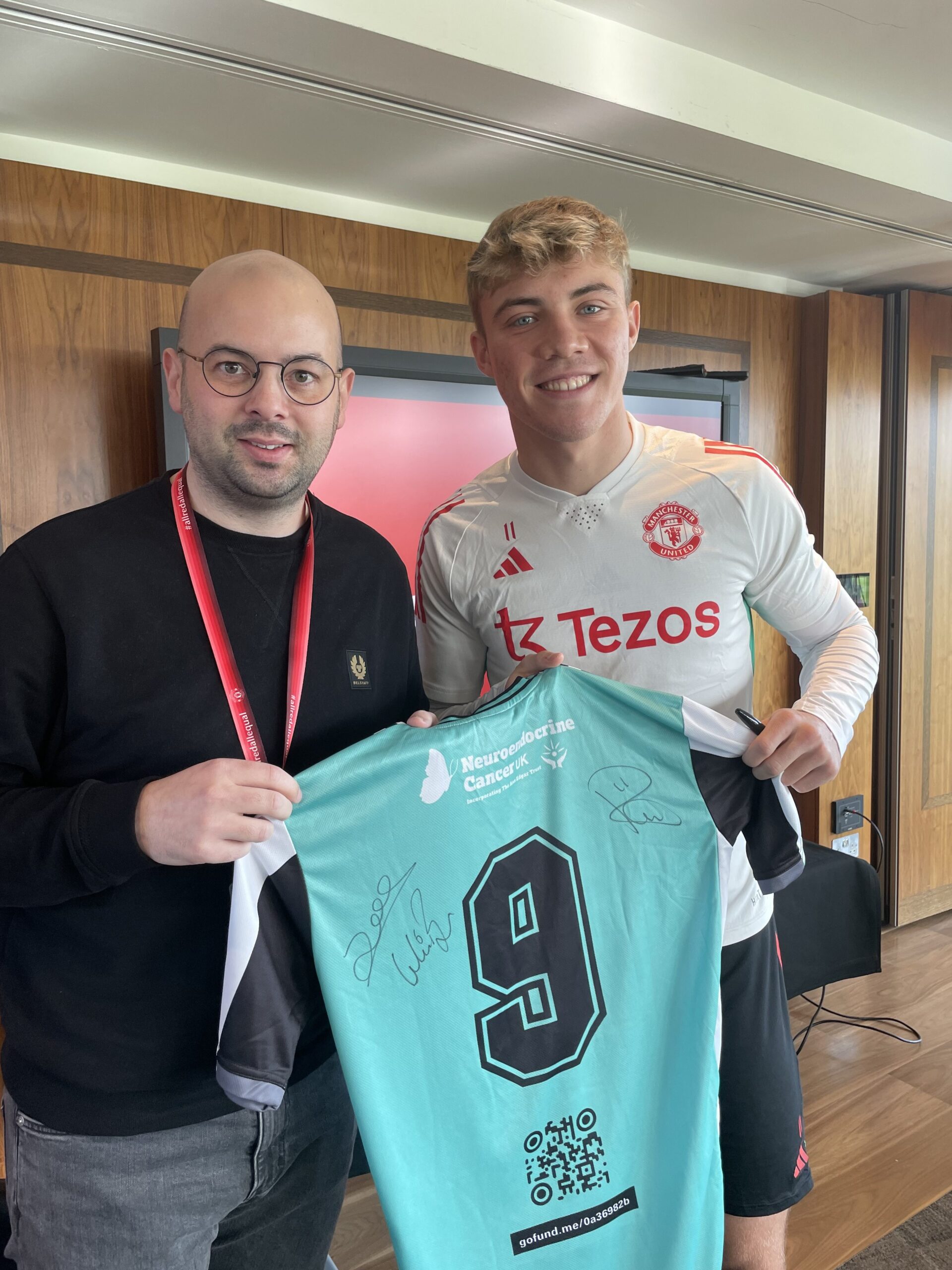
I used to be a keen footballer and cricketer but these days I enjoy watching rather than playing – but that doesn’t stop me from fundraising at these events too. I also enjoy exploring our beautiful coastline and countryside with my partner, Gemma, and our dog, Arnold. Being in nature definitely helps me.
Becoming an Ambassador
So why be an Ambassador? Well, I find it incredible that our NHS still has no formal recognised pathway for neuroendocrine cancer patients. There should be a structured approach to diagnosis, treatment, and follow-up in place, as there are with other, more widely recognised cancers. In my view, it’s only earlier diagnoses that are going to make a difference to us – and we definitely need the ‘age box’ removed from the tick list. I was 34 and although I ticked all the other boxes for a cancer referral, it didn’t happen because I was ‘an under 40 normally fit and healthy person.’ I’m looking forward to helping try to change this.
Chris
19.8.24