|
Getting your Trinity Audio player ready...
|
Name: Julie
Type: MEN1 (Multiple Endocrine Neoplasia)
Hospital: Leicester Royal Infirmary
Date of Diagnosis: May 2025
–
Julie’s Story
My Road to Diagnosis
My mother had MEN1 (Multiple Endocrine Neoplasia) or Wermer syndrome, as it is sometimes called. It’s a rare hereditary disorder causing tumours, usually benign, to develop in endocrine glands, most commonly the parathyroid, pancreas, and pituitary glands. More than 90% of MEN1 sufferers will have developed at least one tumour by the age of 40.
Following genetic testing in 2002, it was confirmed I had inherited Multiple Endocrine Neoplasia Type 1 (MEN1), and from then on, I was put under an Endocrinology Consultant at Leicester Royal Infirmary, and onto a lifetime screening programme. Thankfully, my sister and brother both tested negative.
Going for an annual MRI and bloods with an appointment with my Endocrinologist became routine. I’d get the checks, and it just became part of my life. It almost felt like going to the dentist for an annual check-up.
But in the back of my mind, I felt like a ticking time bomb. I tried to push those thoughts away, hoping as each year went by, I would be lucky and would remain just on annual check-ups. I’d occasionally have other scans, which were just precautionary and again I was not too concerned.
Then, in late 2024, my Endocrinologist told me my gastrin level was high and was rising, so he sent me for a Gallium Dotatate 68 PET scan, which I travelled to UCH (University College Hospital) in London for. I thought it would be another case of everything was ok, as my MRI scans had, to that point, not been a concern.
In May 2025, my ticking time bomb went off.
Following my Gallium scan, I was diagnosed with a Pancreatic Neuroendocrine Tumour (pNET), a functioning Gastrinoma, which explained the fatigue and severe acid reflux I had been suffering from and for which I had been prescribed Omeprazole.
Functioning Gastrinomas secrete gastrin and create excess stomach acid, which can cause peptic ulcers if left untreated. The pieces were falling into place. Without my morning dose of Omeprazole, I felt unwell and developed numerous symptoms even if I was just a few hours late taking it, so I make sure I am never without it.
Looking back, it didn’t register then that I had just been told I had Neuroendocrine Cancer.
It was only when I arrived home that the enormity started to sink in. I was referred to a Hepatobiliary Consultant, and we talked about my options … surgery (a partial or total pancreatectomy) … or a less invasive management tool, Radio Frequency Ablation (RFA), which involved using a heated probe to remove some of the cells within the tumour.
The dilemma I faced was because of the MEN. I am at risk of tumours growing anywhere in my endocrine system, and removing my pancreas was not going to cure the problem. I therefore chose the RFA route, and although not a cure, it will hopefully manage it.
I had my first RFA in October 2025, and despite it being considered low risk, I developed immediate acute pancreatitis and was in hospital for 2 and a half weeks – but then recovered well.
I had a second RFA in January 2026 and am currently awaiting a follow-up scan and results, as another pNET was found during this second procedure. The Gallium scan had also shown areas of uptake in my stomach and duodenum, but nothing visible could be seen during the RFA, so the likelihood is that there are no tumours big enough yet to visibly see, just areas where there is possible cell activity.
I have also been diagnosed with hyperparathyroidism (tumours on my parathyroid glands), which causes calcium to be released from the bones into the blood, resulting in a rise in a high calcium level. I have been referred to an ENT Consultant to review if I need surgery to remove some of my parathyroids. I have also had a bone density scan to see if it has affected my bones, as a high calcium level can cause osteoporosis.
The Way Forward
I continue to learn how to live with Neuroendocrine Cancer. Having lost my mother and uncle to complications from MEN1, I can’t help but reflect on that – but know that their journeys are not my journey.
It has taken me some time to realise that – we are all different.
I feel a bit like I’m living my own ‘Christmas Carol’ story: The Ghost of MEN 1 Past (losing them), The Ghost of MEN1 Present (here and now) and The Ghost of MEN1 Future (what lies ahead).
Support
Neuroendocrine Cancer feels isolating. It’s not something most people have heard of – in fact, no one I know had ever heard of it. I had to educate myself just to be able to explain what it was.
I am the kind of person who wants to know as much as possible, so I joined Neuroendocrine Cancer UK’s Facebook page. And I have found the NCUK website a valuable source of information. I have attended NCUK Webinars and am currently on an 8-week online course with RareMinds, which helps people deal with Neuroendocrine Cancer in the early years of diagnosis.
I also attend in-person support groups as well as my local Cancer Well-Being Centre (where I have hydroxy therapy a couple of times a week). I feel I have joined a new “family” – one that understands what having neuroendocrine cancer means. I also want to be able to make informed choices and know what is happening to me. The RareMinds Counselling I had last year was invaluable, and being able to speak freely to someone who understood how overwhelming my diagnosis was, the insatiable need for information and how to start to deal with the uncertainty that neuroendocrine cancer brings.
Being advised to “concentrate on what you do know and not on what you don’t know” has become my mantra as there is so much to take in and process, certainly in the early stages of a diagnosis. I also have a Macmillan Neuroendocrine Cancer Nurse Specialist who I can contact if I need to. All this support has made a big impact on helping me come to terms with my ‘new normal’.
I am incredibly lucky to have a support network of good friends and family around me – and a supportive employer– and know I can visit my GP if I need to, which is important not only now but also going into an uncertain future.
The Future
As part of learning to live with a rare cancer, I have become more aware of the importance of self-care – my local cancer support centre offers complementary therapies such as Reiki, reflexology, acupuncture and tai chi, and I try to treat myself to a beauty treatment once a month and do Pilates classes. It is so important to make time for yourself – cancer can be physically and mentally draining in equal measures. I saw a dietician in hospital when I had my pancreatitis, and now ensure I follow as good a diet as I possibly can to ensure I am keeping myself as healthy as possible.
I know that I will often have to explain this rare cancer to people, as there are so many people who don’t know of its existence. I always ensure that any healthcare professional I see, whether related to this or not, are fully aware of my MEN1 and neuroendocrine cancer, and there is a mixed reaction; some are aware of them, others not so much, and I do find satisfaction in explaining more about them as it is creating further awareness, which can only be a good thing.
I have a positive mindset and fully intend to live my life to the full. I will always live with uncertainty, and having to wait for scan results can be a worrying time, but I will not let this define me. I love travelling abroad – and I’m off to Mauritius next week (don’t get me started on travel insurance!) – and still intend on travelling for as long as I can, and as much as having a full-time job as an Executive PA allows.
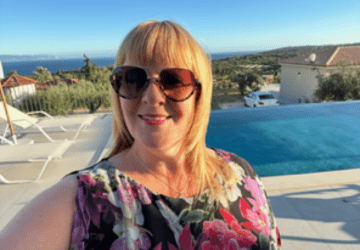
Julie
Written, Feb 2026