|
Getting your Trinity Audio player ready...
|
Name: Jane
Neuroendocrine Cancer Primary Site: Pancreas
Centre of Excellence: Royal Free, London
Diagnosed: 2016
–
Jane’s Story
My Diagnosis
I read about a lot of neuroendocrine cancer patients who have blood sugar issues, so I thought it might be helpful to share my recent experience.
I was diagnosed 9 years ago with a pancreatic primary, already at Stage IV with local and distant metastases.
I have had various treatments, including Lanreotide monthly injections, 4 cycles of PRRT, surgery following spread, 6 months of CAP-TEM, an oral chemotherapy, and recently 2 more cycles of PRRT as part of a ‘rechallenge’ clinical trial.
I am grateful to still be living a decent and fulfilling life with frequent travel to see family in Italy.
Struggling with Symptoms Without Answers
However, certainly over the last couple of years, and perhaps as the tumour burden has increased, or perhaps with my long-term Lanreotide usage, I found myself suffering more and more side effects. Consultations with my NET Centre of Excellence often consisted of discussions about blood tests and scan results. Whenever I brought up symptoms, I didn’t seem to get any satisfactory answers for the way I was feeling. So, I struggled on.
I began to experience more and more episodes of ‘hypos’ (a term used for when your blood sugar levels drop too low, hypoglycaemia). I would become hot and clammy, and need to sit down, with palpitations, especially after breakfast, or after more exertion than normal – perhaps, going up and down stairs a couple of times, or walking up a hill.
I learned I needed to carry a few jelly babies or a carton of orange juice with me at all times and after eating them, or drinking the juice, I would ‘feel normal’ again.
A Long Road to Being Heard
Over recent years I reported this to my GP who would check my Hbac1 level and suggested doing a finger prick test to check blood sugars, but by the time I had sat down, got the kit out, and tried to prick my finger, I would have returned to normal.
My usual GP then went on sabbatical. Back to square one.
But I knew something wasn’t right. I felt much older than my years.
My appetite had deteriorated to the extent that meals gave me no pleasure but were just a necessity. Recently I started losing weight, coupled with feeling worn out most of the time, everything an effort, ongoing pain, raging thirst, peripheral neuropathy alongside the usual gastric issues we neuroendocrine cancer patients may have.
I took pancreatic enzymes – Creon – to ensure I was absorbing nutrients from the food I was eating. I had been officially pre-diabetic because of the Lanreotide injections for quite some time, as they suppressed insulin production in me. I was originally prescribed them 4 weekly, but I am now 3 weekly, which is probably when my problems were exacerbated.
A Breakthrough at a Patient Support Meeting
I started to monitor my Hbac1 readings myself (Jane, using what??) which varied between ok to pre-diabetic, to borderline to within the diabetic range. I could see the clear correlation between tumour burden and the effect of treatments. Treatments resulted in tumour shrinkage, and Hbac1 going down.
Then last year, whilst attending one of the Neuroendocrine Cancer UK Patient Support Meetings, blood sugars came up as a discussion topic. The meeting was led by Nikie Jervis, senior clinical nurse specialist at the charity. She explained to me what was happening. I am producing insulin but due to tumour burden or treatments, my pancreas is sluggish. Anytime I did a bit ‘more’ – like rushing around or walking further – it was slow to catch up, hence the hypos. She suggested talking to my GP about Metformin, a very common diabetes medication as it might make it work more efficiently.
Getting My GP on Board
I went away to read up about Type 3c Diabetes, which is largely caused by damage to the pancreas or as a side effect of medication.
It all made sense.
By now, I had a new, younger GP on board who was very willing to listen. She sent me for further blood tests and a Doppler scan (to check my cold hands and feet weren’t due to circulation problems).
My GP reached out to my team at my NET Centre of Excellence, but they thought the connection unlikely. They suggested that with my elevated Hbac1 it was unlikely I had hypoglycaemia, rather perhaps my other medication or bizarrely poor sleep (caused by the peripheral neuropathy), lack of appetite and pain. They suggested the elevated Hbac1 might have been exacerbated by steroids given during my clinical trial participation.
Thankfully my new GP was still onside. She agreed to try a low dose of Metformin.
–
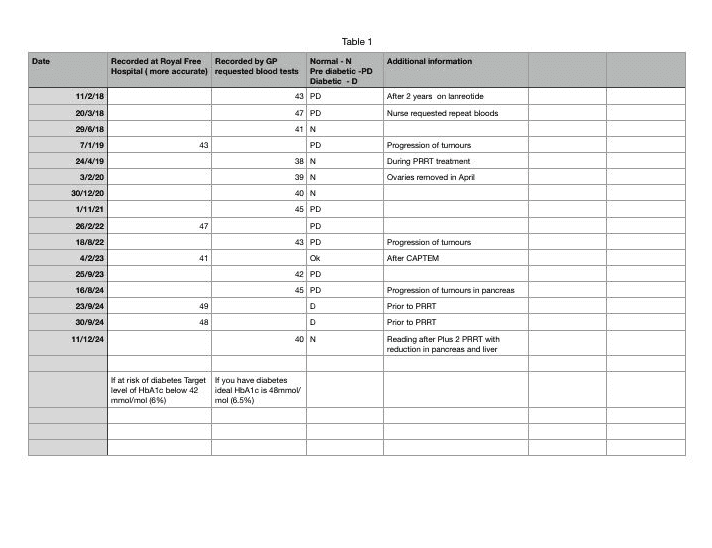
–
Feeling Like Myself Again
What a difference! It’s early days but I definitely don’t feel so utterly worn out all the time. I almost feel like me again. And the best bit – I look forward to food, I actually have an appetite.
If I could share one tip, it would be: don’t be afraid to persevere for answers, even if you are knocked back. Self-advocacy is hard work, but it usually pays off.
So, a huge thank you to Neuroendocrine Cancer UK for listening, understanding, and explaining about Type 3c Diabetes – and to my GP for listening.