

|
Getting your Trinity Audio player ready...
|
Merkel cell carcinoma (MCC) is a rare type of neuroendocrine cancer that develops in the skin. It often appears as a firm, painless lump and can grow quickly. Although it most commonly develops on sun-exposed skin, it can occur elsewhere on the body. Early diagnosis and appropriate treatment are important, and your healthcare team will consider your individual circumstances when planning your care.
This page explains more about MCC, including possible causes and risk factors, symptoms, how it is diagnosed and monitored, and the treatments you may be offered. It also includes information about living with MCC, follow-up care and ways to take an active part in your care.
Use the links in the box to find the information that is most relevant to you.
What is Merkel cell carcinoma?
Merkel cell carcinoma (MCC) is a rare neuroendocrine cancer of the skin. Around 5% of all skin cancers are considered to be rare, and MCC accounts for about a third of these.
MCC is a firm, painless, skin-coloured to red-violet lump that usually develops on a sun exposed part of the skin. It may also originate on areas of the skin usually covered by clothing, for example the genitals.
The anatomical distribution of MCCs:
- Head and neck: >35%
- Extremities (upper limbs – shoulders, arms): >20%,
- Extremeties (lower limbs – hip, legs): >25%
- Other sites (including torso, genitals and ora-nasal cavities): ~10%
- Unknown primary: ~10%
Not all MCCs have the same appearance. Any new, changing or unusual nodules or lumps on the skin should be checked by a doctor or dermatologist.
It can grow rapidly (over weeks) and may be highly aggressive, spreading to surrounding tissues and local lymph nodes. Left undiagnosed or untreated, it can spread to other sites of the body including internal organs (lungs, liver and bone).
Risk factors for MCC
Immunosuppression
Post-transplant patients, those with HIV or immunodeficient conditions, or immunocompromised individuals (e.g. those with blood cancers and/or those receiving immunosuppressant treatments), are more likely to be diagnosed with MCC.
Older than 50
The risk of MCC development increases with age. Although the majority of those affected are over the age of 50, MCC can occur in all ages.
UV exposure
More than 80% of MCCs develop in sun-exposed skin (e.g. head, face, arms, hands, legs), however MCC may also develop on the torso, back and genitalia.
Fair skin
More than 90% develop in those with light skin tone – it is 16 times more likely to occur in those with pale skin than those with dark or very dark skin.
Merkel cell polyomavirus (MCPyV or MCV)
This virus lives harmlessly on the skin in most healthy people ( >80% of the population). Once acquired (usually during childhood), MCPyV becomes a life-long component of the skin flora. The virus can get trapped into a Merkel cell, leading to virally induced cellular transformation – although this is rare. MCC is not contagious – the virus is inactivated when it is trapped into the Merkel cell.
Genetic mutations
For example mutations in tumour suppressor ATOH1 and PIK3CA genes have been found in MCC subsets.
Diagnosis and management of MCC is challenging
Patients as well as physicians may initially mistake these tumours for benign (non-cancerous) lumps, the single most common misdiagnosis being a cyst or folliculitis (inflamed hair follicles) or other skin-based lesions.
MCC is rare, so other reasons for a skin lump are more likely and more commonly suspected.
In some cases, the MCC may arise in locations that makes it difficult to find them, delaying diagnosis. About 5% of MCCs occur in the mouth, nasal cavity and throat, or the primary may be and remain unknown, making them difficult to detect in the early stages.
There are currently no specific blood tests – known as biomarkers – that can reliably predict or monitor MCC, and biopsy remains the gold standard for diagnosis.
Research is underway to try to identify a reliable and effective biomarker to help improve diagnosis and surveillance.
CT (chest/abdomen/pelvis) is agreed standard practice to prove or exclude secondary disease and can help confirm staging and inform treatment planning.
MRI and/or FDG-PET imaging may also be undertaken to assist in treatment decision-making.
Sentinel node biopsy and/or lymph node mapping may be undertaken if surgery is planned.
Diagnosis and living with MCC
A diagnosis of MCC can bring questions, uncertainty and a range of emotions. Information and support are available to help you understand your diagnosis and navigate what happens next.
Just diagnosed with neuroendocrine cancer? Access information and support to help you navigate the early days after diagnosis.
Treatments
Treatment will depend on the site, size and stage (whether and to what extent it may have spread).
Other considerations will include overall health and the likely outcomes and potential effects of treatment.
Treatments may include one or a combination of the following:
- Surgery
- Immunotherapy
- Chemotherapy
- Radiotherapy
- Clinical trial
- Supportive care
Follow up
Follow up should also be individualised according to recurrence risk, potential future options, overall health and patient preference.
How you can be part of your care
You are a key part of your team. You can help by:
- Reporting new symptoms or any changes in current symptoms or overall health
- Asking questions if at all uncertain or you want more information about your diagnosis and/or plan of care
- Attending appointments made – and checking up with the team if you haven’t received an appointment according to your agreed plan of care.
- Let your team know of your preferences and wishes regarding care – what is most important to you.
Keep healthy habits
To protect yourself, make these habits part of your daily healthcare routine:
- Minimise exposure to UV: seek the shade, especially when the sun’s rays are strongest, which is usually between 10 am and 2 pm and/or when your shadow is shorter than you, avoid sun bathing and tanning (including use of sunbeds) and minimise risk of sunburn – especially during treatment and to a surgical site.
- Cover up with clothing, including a broad-brimmed hat and ultraviolet-blocking sunglasses.
- Use a high SPF broad spectrum (UVA/UVB) sunscreen every day on all exposed skin (even on cloudy, rainy or snowy days) and reapply it every couple of hours while outside.
- Work with your specialist team. Agree and attend appointments for the first 2 to 3 years after treatment; this will be every 3 or 4 months. Alert them to any changes – appointments can be rescheduled if you need to be seen earlier.
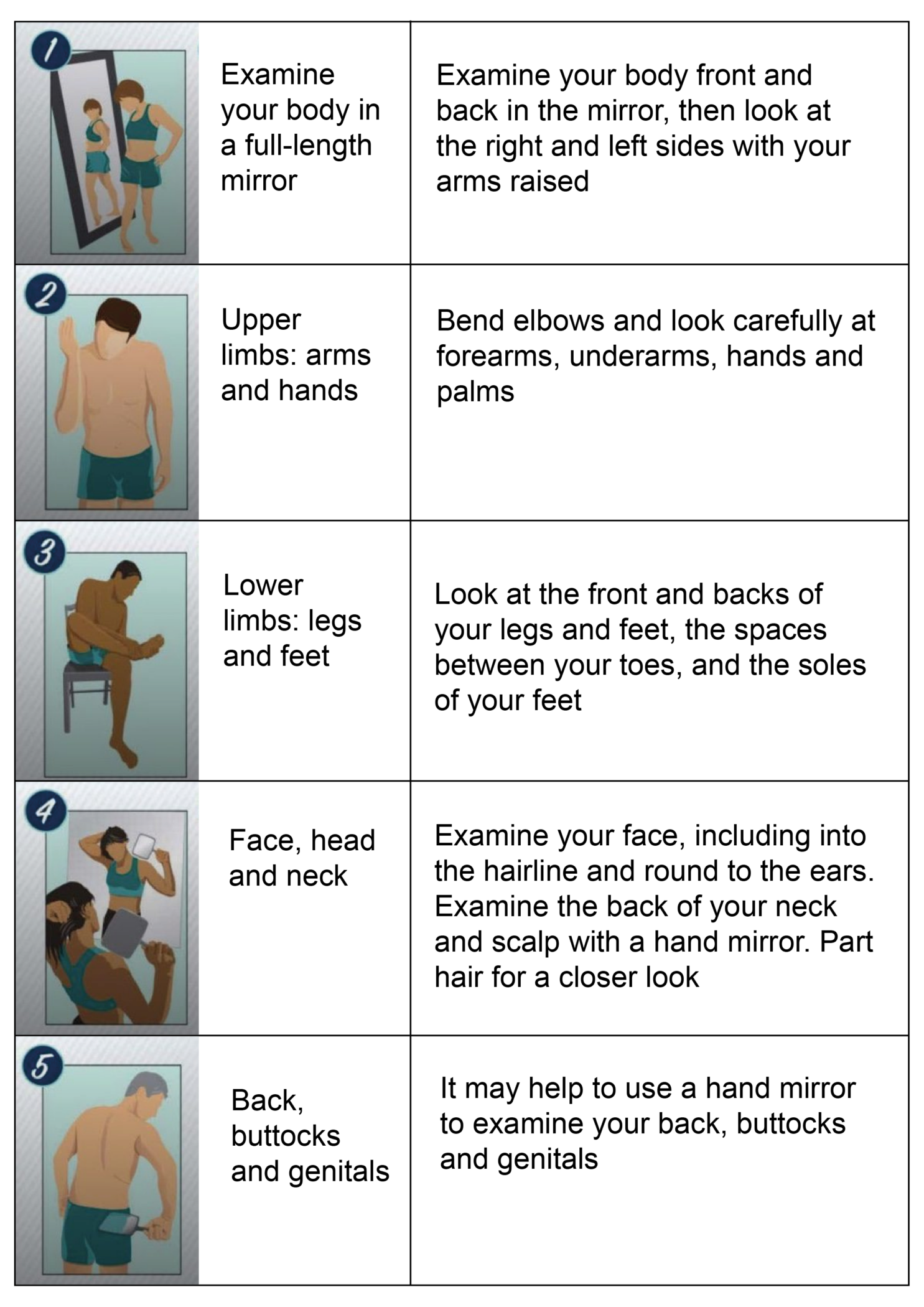
Examine your skin regularly
Examine your skin all over every month, being vigilant for any spot that is different from others, or that changes, itches or bleeds or is similar to your previous MCC (or at same site) or other skin lesion – use ABCDEF as a helpful checklist:
A – is for asymmetry – does one part of the blemish look different from the other?
B – is for border – is the spot clearly defined or is it irregular in shape?
C – is for colour – is it the same colour all over ? What colour is it?
D – is for diameter – how big is it?
E – is for evolving – is it changing in shape, size, colour ? How quickly?
F – is for firmness – is it a firm spot/lump? Does it hurt to touch?
If you have difficulty in doing a self-exam, ask for help (e.g. partner, carer or practice nurse). Use one or two mirrors to get a clear view.
More information
For more information about MCC, download our MCC booklet.
Stories from our community
Hear from people connected to neuroendocrine cancer as they share their experiences, perspectives and insights – from living with the condition to caring for, treating and supporting those affected.
Remember
Remember: every person’s experience with Merkel cell carcinoma is different – there may be shared similarities, but each journey is unique.
Your healthcare team will support you every step of the way, guiding your treatment, care, and follow-up. We’re here alongside them, offering additional support and information whenever you need it.
The information on this page is based on available clinical expert guidelines and publications. It is for informational purposes only and should not be considered professional medical advice.