|
Getting your Trinity Audio player ready...
|
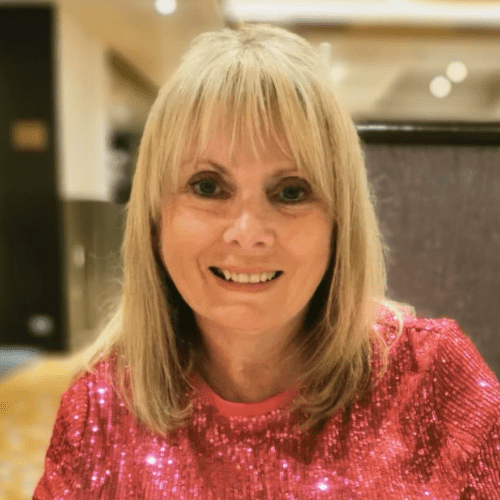
Name: Carolyn
Neuroendocrine Cancer Site: Bowel
Hospital: The Royal Free
–
Carolyn’s Story
My name is Carolyn Evans, and in August 2005, I was in hospital recovering from bowel surgery when a nurse came up to me and said: “Don’t stop eating your lunch, I’ve come to discuss your cancer with you”.
CANCER??… That word hadn’t been mentioned to me before & never in my wildest dreams did I think I had the dreaded Big C. At that moment my world came crashing down. I was 49, a single parent with 2 daughters and I really thought it was the end. The nurse went on to tell me that I had a very rare cancer called ‘Carcinoid’ (very old terminology now) and they had only seen one other patient with this in the previous 5 years.
Prior to my operation, I had been having intermittent bouts of abdominal pains with diarrhoea, bloating & fatigue. I had consulted at least 7 different GPs over a few years, but they were dismissive and put these attacks down to IBS & stress. As I had gone through a very stressful time in my life, I initially thought that this could be feasible. After a particularly bad attack and another visit to a GP who prescribed more painkillers, I ended up in A&E, where I collapsed. This led to a stay in hospital having investigations, which showed I had a twisted bowel, so I had a right hemicolectomy to remove the affected part of the bowel.
After I received the cancer diagnosis, the local team didn’t know what to do with me and suggested I had 6 months of continuous chemotherapy which they normally gave to bowel cancer patients. I later discovered that this was useless for NET patients (not to be confused here with NEC patients).
During my weekly visits to the chemo ward, I felt very isolated. There were various support groups for the more common cancers and other patients seemed to have treatment plans, which I was lacking.
It didn’t help that I had a cancer that no one had heard of. My partner started to do some research online and came across Dr (now Prof) Martyn Caplin at The Royal Free, London, and after contacting him, he agreed to see me. There were no Centres of Excellence back then. This is when I met Cathy Bouvier, who became my first NET Nurse. I had to get my GP to do the referral and once I saw the team at the Royal Free London, my prognosis didn’t seem so bad.
After 5 days of scans and every test necessary, it appeared that I was low grade, stage 3. Then began the process of ‘Watch & Wait’. I was told that although there was no evidence of disease at that time, it was inevitable that it would come back so I would be monitored forevermore. A good thing.
My routine scans and follow-ups continued uneventfully for 5-6 years until I was sent for a Gallium scan, which wasn’t available when I was first diagnosed.
That showed up multiple liver mets, along with others dotted around my body. It was at that point I was started on monthly Lanreotide injections. Life continued quite normally with me working full-time. I had an admin job within the NHS, thinking I would like to give something back for all the treatment I had received. I also helped with my elderly mum and new granddaughter. Keeping busy meant I had very little time to dwell on my illness.
By 2016, my tumours were progressing so my Lanreotide injections were increased to 3 weekly. This kept me relatively stable for a year or two and then it was recommended for me to have PRRT. I had 4 cycles on a clinical trial, as it had been withdrawn by NICE at that time, and I was treated as a private patient at The Royal Free. Once this had finished in 2019, I was closely monitored for 2 years. In 2020, COVID hit us & due to a restructuring at work, my job became more and more stressful…. something that, as a NET patient, I knew I didn’t need, so I decided to retire in 2021.
I had great plans for my retirement. I was going to concentrate on getting fitter and by now I had 3 young granddaughters, so I planned to get more involved in helping to look after them.
However, during my first week of not working, I received an unexpected phone call from a doctor saying they had re-looked at my scans from the beginning of PRRT to the end of my monitoring period & there had been some progression so I would need more treatment.
In 2022, I had another 2 cycles of PRRT, as I hadn’t used any of my NHS quota and I found cycles 5 & 6 a lot easier to tolerate.
Just before Christmas I was told that this extra PRRT hadn’t worked so it was time to decide what treatment I should have next.
In 2023, I had a course of radiotherapy on my spine as I now had many bone mets. CapTem & Everolimus were discussed, but I’m not an ideal candidate for either, so eventually it was decided to increase my Lanreotide injections to 2 weekly and that is where I am today, just hoping that the extra Lanreotide keeps my tumours stable. I long to hear that word again as I haven’t heard it for a while!
When I was first diagnosed I never thought I would see 60, so when I did hit the magic number several years ago, I celebrated for a whole year. I have also seen both my daughters graduate and get good jobs, marry, and have daughters of their own. I have travelled extensively and had 2 career changes. Things I would never thought possible back in August 2005, and a lot of it is due to the excellent care I have received.
I think one of the reasons I have managed to deal with my illness is that I have always been busy and active and like to plan nice things to look forward to. I like socialising with family and friends, attending concerts, and doing as many things as I can to keep my mind occupied.
I have now made it my mission to support and offer advice for newly diagnosed patients. That is something I really wish I had had in those early days when I was struggling to cope. I have also attended focus groups for drug companies & Cancer Research UK. I am passionate about promoting awareness of NETS and am really looking forward to continuing this as an Ambassador for Neuroendocrine Cancer UK.
March 2024