|
Getting your Trinity Audio player ready...
|
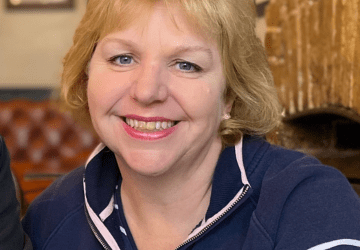
Name: Angela
Neuroendocrine Cancer Primary Site: Ileum
Specialist Centre: Southampton
Diagnosed: 2019
–
Angela’s Story
–
To Work or Not to Work? That is the question. Coming to terms with NETS
Life Before Diagnosis
In October 2019 I was working 14-hour days as a GP Partner, doing extra on-calls and working as a national telephone triager for 111 at weekends. Looking after and supporting my children was all part of a very busy and exhausting life. I could never see an end to it – and I couldn’t just get off that merry-go-round. I have a Masters Degree in Palliative Medicine, and I was always being asked if I could do extra work for the local hospice or the CCG with their cancer work – but how could I? There just weren’t enough hours in the day.
Diagnosis and Surgery
At the time of my diagnosis (grade 1, stage 3c Ileal NET) 5 years ago I was exhausted and worried but oddly relieved to be taking a short break from work as I was in ‘sub-acute bowel obstruction’ and needed to rest. I hadn’t taken notice of the bouts of diarrhoea and abdominal pain over the preceding months. After the operation I felt really relieved to have had everything they could see or feel removed – now I could move forward and get back to work.
However, my body had other ideas. I continued to have abdominal pains and a lot of bowel symptoms including bursts of unexpected diarrhoea. My bowels were impossible to manage with some episodes of embarrassing incontinence – all I can say is ‘never trust a fart over 40 (years old)’ as the saying goes! I also had a rare post-op blood clot in the blood supply of my small bowel which needed treating. I took a year of paid sick leave from work which was during the Covid pandemic. I was under a NET dietician for 2.5 years and now I do my best to manage my bowels with a zero-fat, fibre-free diet and take cholestyramine and handfuls of loperamide with varying success.
Financial Struggles and Career Adjustments
I was a self-funded mature medical student and over the years money has been tight. We did not take out critical illness cover as there was no spare money when we took out our mortgage all those years ago. We were never going to get ill, that happens to other people….
When cancer struck in October 2019 all my money was going straight ‘out the door’ to fund my daughter’s ballet training which wasn’t a problem up until then as I could do the extra work to pay for it. One always assumes that life is going to carry on as normal forever and that one has years of working life ahead (with earning potential). There will always be time in the future to build up a nest egg for retirement once the children have become less expensive …. how wrong could I have been? I never worked full-time again, and I am now astonished at how secure everyone else appears to be about their futures.
After a year of sick leave my symptoms weren’t improving so I took semi-retirement on medical grounds in November 2020. I wasn’t well enough to go back to seeing patients face-to-face, but we had no savings, so I had no choice but to look for another career path as the bills still had to be paid.
A New Career Path
Miraculously a suitable job came up at the local CCG for a GP Clinical Lead for Cancer where I could work remotely part-time from home near my own bathroom. The following 4 years were very rewarding and involved new experiences like appearing on television and radio and new opportunities opened and I became a national GP advisor for NICE as well.
All these experiences were only possible because of the cancer, without it, I would never have come up for air and wouldn’t have been able to pursue these opportunities that used my qualifications and experience in a new way. I was able to rejoin the NHS pension scheme and accrue another small pension too which has been a godsend.
Progression of Cancer and Work Struggles
As the years went by, I started to develop new pains and symptoms suggestive of metastases and carcinoid syndrome and in May 2023 it was finally confirmed that I have liver, pelvic and ovarian metastases. This news was such a relief to me all my symptoms finally made sense and I no longer felt gaslit. Different imaging was needed to prove what I already knew.
But as 2023 progressed I had to increasingly switch off the camera and sound on my computer during Zoom meetings and had to dash and remain stapled to the toilet or had to lie down between meetings and rest and just work longer than contracted hours from home to ensure that all my work was completed to my own high standards.
It was a real struggle at times which I continued doing for 8 months. No-one at work was aware of any of this except my line manager. I used to feel like a jack-in-the-box popping up and switching a smile on with bright eyes and a bushy tail and rebooting my apparent energy for the span of an online meeting. It was exhausting and increasingly untenable. I chatted with a GP colleague who was the first person to question why I was still working – this made me stop and think about whether or not I could afford to fully retire and stop altogether. , My symptoms continued to worsen and by October 2023 I ‘run aground’ and had no choice but to stop because of Octreotide side effects , carcinoid syndrome, my bowels, and my rapidly deteriorating heart.
Making the Decision to Retire
Since diagnosis I was always worried about money and about what income I could reasonably be expected to earn despite having so many health challenges, I pushed myself to keep going. When I finally ran aground in October 2023, I was put in touch with a trustworthy independent financial advisor who provided us with the reassurance that we needed which meant that I could stop worrying and not feel guilty about fully retiring. In a way this gave me the permission I felt that I needed to stop work. I fully retired on medical grounds in July 2024.
Now my time is mostly my own and if I need to dash back and forth to the toilet (up to 11x in a morning), or be stapled to it for a few hours, or if I am too exhausted to do anything, have only had a couple of broken hours of sleep the night before and must rest… who cares? It doesn’t affect anyone else… there is no continual pressure to attend meetings, write reports etc when incapacitated. It really does take the pressure off, which has also helped to reduce my carcinoid symptoms’ severity and frequency as stress is a trigger for them.
Finding a New Normal
At times when I feel better and the bowels settle, I make the most of it (within reason) going for short walks in the beautiful surrounding countryside, heart allowing, and I pace myself, and rest when I need to. Being flexible is the name of the game, if I don’t feel well enough, I say so and don’t go – and rest instead. One has just to listen to one’s body, ‘go with the flow’ and adjust one’s expectations accordingly for a better quality of life.
I am extremely grateful for all the support my GP, NET team, Cardiologist and work gave me which enabled me to get my medical retirement sorted. The reports and clinical details weren’t great reading, but the truth rarely is if you are ill enough to merit medical retirement. The trick is not to dwell on the negatives that are down there in black and white.
In the brief moments when I feel quite well, I do feel guilty for not working, especially as my husband still goes off to work every day…. but fast forward an hour ahead and the symptoms will have all kicked in again which confirms why I can no longer work, and any feelings of guilt disappear.
Having been a driven, career-orientated and focussed person all my life it has taken a great deal of adjustment mentally to come to terms with the loss of working life and the purpose it provided. Counselling has helped me process that loss and I have found new passions and hobbies which provide me with new challenges and great enjoyment – art, singing, learning Italian on Duolingo, reading books for two monthly book clubs along with seeing friends – all of which are great, and an even better, substitute for working life.
Life is good. Not perfect by any means – but when one can embrace a ‘new normal’ and be grateful and enjoy every day and everything that life has to offer, there is much joy to be had.
Angela
March 2025
Further Support: Work and Employment with Neuroendocrine Cancer.