
The Less Survivable Cancers Awareness Week observed annually in January, highlights the persistent and high priority need for better early diagnosis, research, and funding for six named cancers* that have significantly lower survival rates than others, aiming to double them by 2029 – by closing the “deadly cancer gap”. (*brain, liver, lung, oesophageal, pancreatic, and stomach)
The “deadly cancer gap” refers to the stark difference in survival rates for certain cancers in the UK, which are much lower compared to others.
Led by the Less Survivable Cancers Taskforce (LSCT), the campaign focuses on symptoms, late diagnoses, and closing the research gap to improve patient outcomes: areas highlighted and echoed across the rare and less common cancer community, including those diagnosed with neuroendocrine cancers, particularly, in this instance, neuroendocrine carcinomas.
Understanding Neuroendocrine Carcinomas (NECs)
Neuroendocrine carcinomas (NECs) are a rare and aggressive type of neuroendocrine cancer, accounting for around 30% of all neuroendocrine cancers reported.
Unlike well-differentiated neuroendocrine tumours (NETs), NECs are poorly differentiated and have a cell growth and replication rate that is as fast—or even faster—than many more common cancers. This impacts treatment options and can significantly affect overall survival.
Where Do NECs Occur?
NECs rarely start in the brain or liver. However, they can develop almost anywhere in the body, including several sites highlighted by the Less Survivable Cancers Taskforce (LSCT):
- Lung
- Oesophagus
- Pancreas
- Stomach
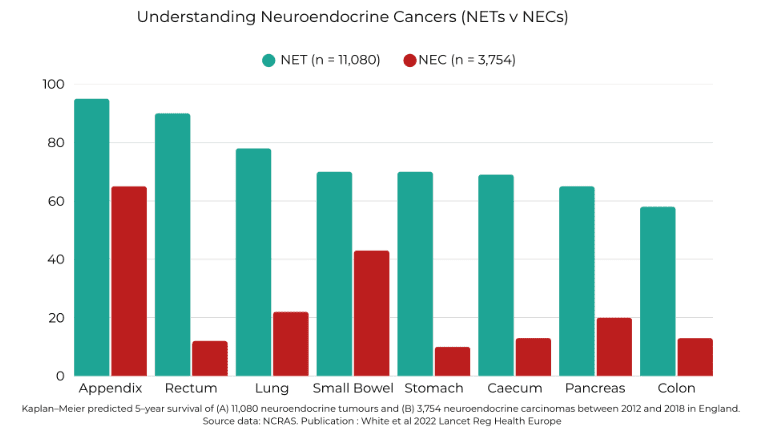
Survival Rates: NET vs NEC
The difference in 5yr survival/outcomes between NETs and NECs is striking. Here’s an example based on lung neuroendocrine cancers:
Primary Lung Neuroendocrine Tumours (NET)
- Typical carcinoid: >87%
- Atypical carcinoid: >53%
Primary Lung Neuroendocrine Carcinomas (NEC – Large Cell NEC)
- 5-year survival: <20%
How Does This Compare to Other Lung Cancers?
- Non-small cell lung cancer (NSCLC):
• Stage I: >90% (dropping to <20% in advanced disease)
- Small cell lung cancer (SCLC): <10%
- Mesothelioma: <7%
Why This Matters
The difference in outcomes between NET and NEC is significant. It is vitally important that you and your medical team are clear on whether your diagnosis is NET or NEC. This distinction guides and informs treatment decisions and helps set realistic expectations.

While these statistics may show an overall picture, behind every diagnosis lies a unique personal story and experience.
Life expectancy is not fixed. No one can tell you exactly how long you will live.
Factors such as the stage, grade, and location of the cancer, your overall health, and how well you respond to treatment all play an important role. Personalised treatments designed for you and your specific cancer can help you live longer and enjoy more time with the people who matter most to you.
Further information about neuroendocrine cancer is available throughout our website:
www.neuroendocrinecancer.org.uk
For information on support services – visit our support page – or call us:
Our Helpline is open Tues-Thurs 10am – 4pm
Or complete our Contact form – available HERE